Author Archives: R-B

Designing a RC snubber circuit

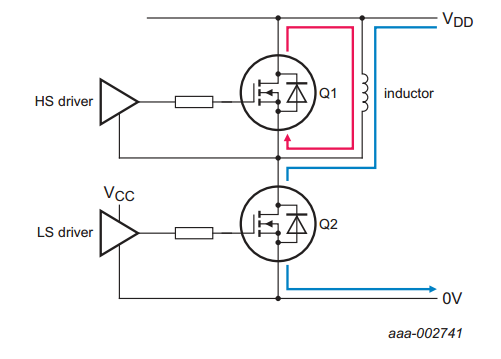
In applications including power electronics, reverse recovery effects are very common and can induce unnecessary high-frequency oscillations in the circuit. This application document from NXP semiconductors describes the design of a simple “RC snubber circuit” for suppressing the oscillations. The technique requires the extraction of the circuit parasitic capacitance and inductance, and has been illustrated well with an example in the document.

Reverse recovery effects in H-bridge


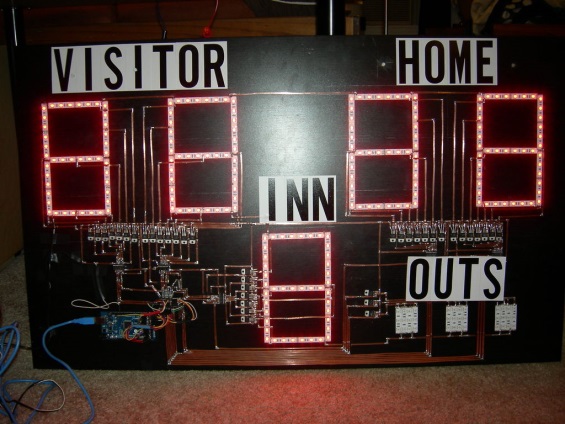
DIY remote-controlled electronic scoreboard using LED strips

Most electronic scoreboards are expensive, and not everybody can afford them. This instructable is about a DIY scoreboard for softball that can be constructed for less than $100. The project uses LED strips to make seven segment digits, which are controlled by an Arduino Mega board through shift registers. The scoreboard displays the visitor and home team scores to 2 digits, the inning to 9 and the outs to 3. The display is controlled through an IR remote.

Remote-controlled scoreboard using LED strips

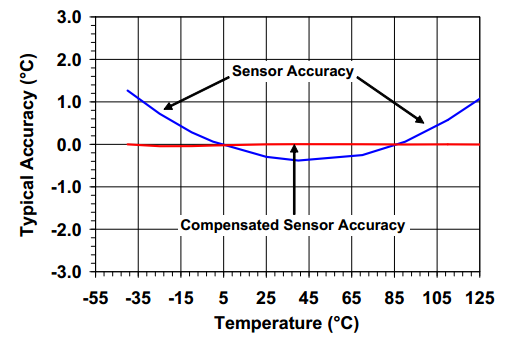
Temperature sensor accuracy improvement using a PIC MCU

The accuracy of most of the current IC temperature sensors is about ±1°C at room temperature. However, at hot and cold temperatures, the uncertainty increases exponentially, resulting in a parabolic-shaped error curve. This application note describes a technique to enhance the accuracy of the sensor by modeling the error curve and use it to compensate for the sensor drift at a wide range of operating temperature. A PIC MCU is used to compute the equation for the curve and apply it to the sensor output to provide a more accurate temperature reading.

Temperature sensor accuracy improvement

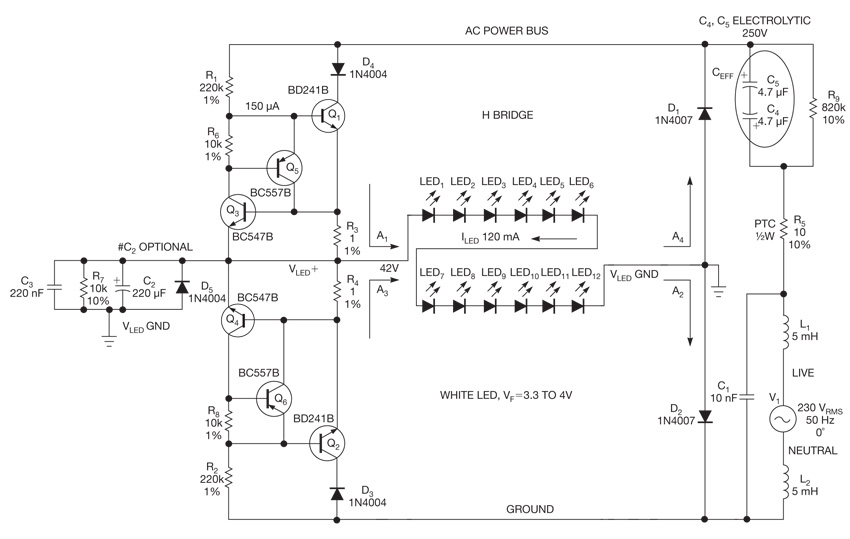
H-Bridge to drive white LED arrays directly from the AC mains supply

The classical H-bridge circuit is widely popular in driving DC motors in robotics applications. This article talks about a novel application of the H-bridge circuit for driving white-LED arrays directly from the AC mains in full-wave current-limited mode to realize an excellent flicker-free, energy-efficient solid-state lamp. The circuit controls and maintains the LED excitation current in both negative and positive half cycles of the excitation voltage to a constant level by way of electronic switches operating alternately during the positive and negative excursion of the excitation voltage.

H-bridge circuit for driving white LED arrays

Low-cost thermostat design for cooking appliances using PIC10F204

Countertop cooking appliances, such as electric ranges and skillets, use an adjustable thermostat to vary the heat output. In traditional appliances, a mechanical thermostat was used in series with the heating element to control the current through the element. While this technique is inexpensive, it is less accurate and less reliable over time because the mechanical components wear out. This application note from Microchip describes a low-cost microcontroller-based design which eliminates these drawbacks. The solution uses the PIC10F204 microcontroller, which gathers user inputs from a potentiometer and control current to the heating element via a triac. The application note also discusses triac theory in brief. Power supply for the PICmicro is derived directly from the AC lines using a zener diode and resistors. The design also implements two additional features: (1) a status LED indicating the range is on or off, and (2) a safety feature that automatically shuts the range after 2 hours if it is left unattended.
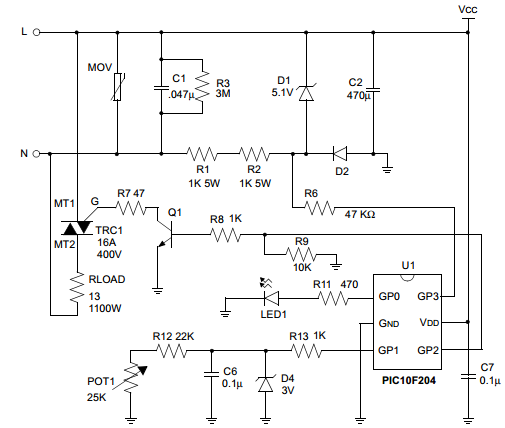
Low-cost thermostat solution for electric range
« Older Entries Recent Entries »