Author Archives: R-B

Chip-On-Glass (COG) technology for LCD displays
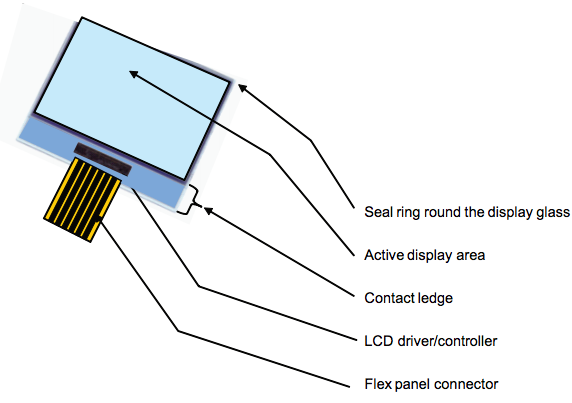
LCD displays are commonly supplied as a module with a built-in driver circuitry usually mounted on a PCB at the rear of the module. While this strengthen the module mechanically, it has some drawbacks such as it increases the thickness of the display module and raises the manufacturing cost. NXP semiconductors describes the Chip-On-Glass technology (COG) in this white-paper, whereby the integrated circuit driving the display mounts directly on the display glass, thus reducing the system cost. COG is a very reliable and well established technology, and offers very thin profile LCD display modules at lower cost.
Chip-On-Glass LCD technology
Laser gun shooting game

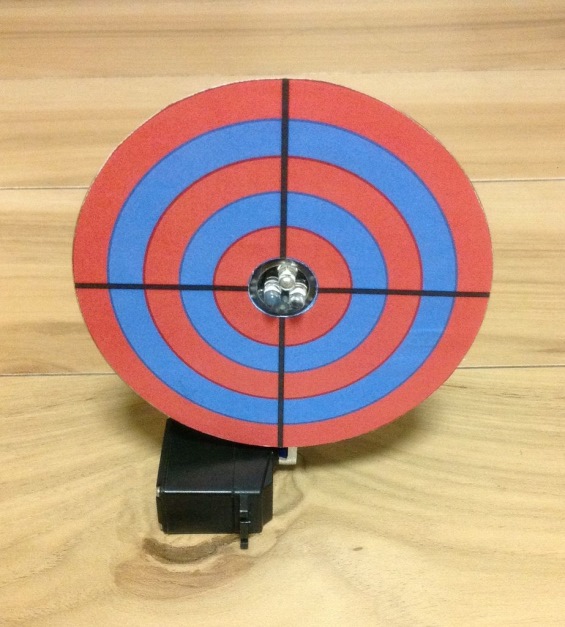
Summer is at its peak and if you are looking for an indoor fun project, you might be interested to build this Laser Shooting Game. The project uses two Arduino mini boards; one for a target board and other for a laser gun. The target board has three IR photodiodes placed at the center to receive the laser beam. When the laser hit the target dead center, it is flat on the ground through a servo mechanism for a few seconds and rise up again for another shot.

Laser Shooting game

Here’s a video showing the game in action.

Arduino RoverBot receives commands from a TV remote

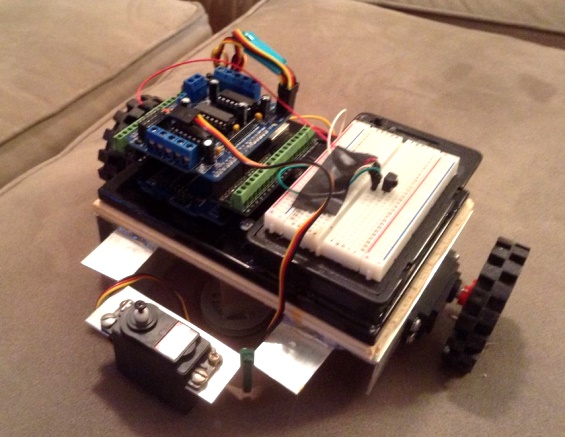
A 15 year old Arduino hacker has written this instructable on building an Arduino RoverBot that is controlled through a TV remote. The Arduino-IRremote library is used to decode the IR signals received from the remote. The RoverBot is coded to drive forward and backward by pressing buttons ‘2’ and ‘8, whereas turn left and right using ‘4’ and ‘6’ buttons on the remote. To stop the RoverBot you need to press ‘5’.

Arduino RoverBot controlled by a TV remote

MikroElektronika’s new Thunder Click board

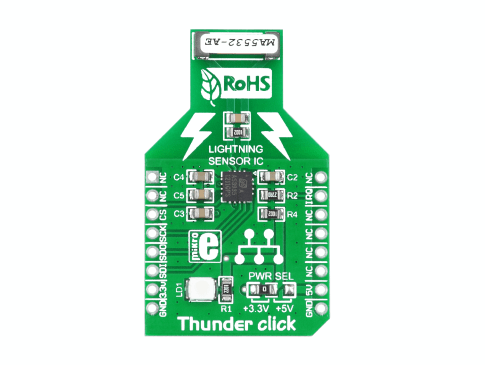
MikroElektronika introduces Thunder Click board which has AS3935 lightning sensor as well as MA5532 coil antenna. It is capable of detecting potentially hazardous lightning activity in the vicinity and provides estimated distance to the center of the storm. Thunder click communicates with a host microcontroller via SPI lines, and is designed to work with both 3.3V or 5V power supply.

Thunder Click lightening sensor

Key features

  • Lightning Detector warns of lightning storm activity within a 40 km radius.
  • Distance to the head of the storm down to 1 km.
  • Detects both cloud-to-ground and intra-cloud (cloud-to-cloud) flashes.
  • SPI communication interface.

SPI7SEGDISP4.40-1R LED displays are back in stock

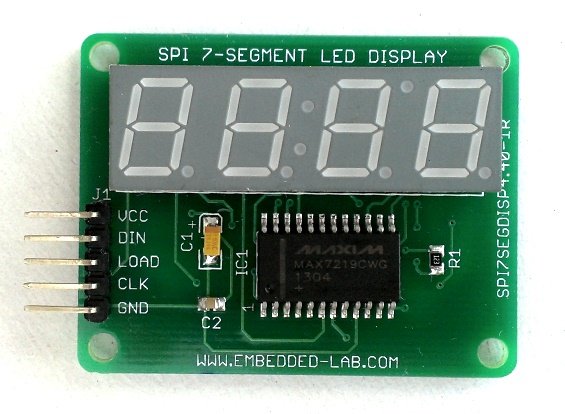
SPI7SEGDISP4.40-1R is a serial 4-digit seven segment LED display based on MAXIM’s MAX7219 device. This display module can be interfaced with any microcontroller that has 3 I/O pins available. If the microcontroller features a built-in hardware SPI, then the display module can be interfaced as a SPI slave device. In that case the SPI signal lines SDO (serial data out), SCLK (serial clock), and SS (slave select) from the microcontroller can be directly connected to the DIN, CLK, and LOAD pins labeled on the display module. CS is active low signal.

In case the host microcontroller doesn’t have a hardware SPI module, the interface can be implemented in software. Click here for an example that illustrates how to write a software SPI routine to drive the display module with three general purpose I/O pins of the PIC12F683 microcontroller.

SPI7SEGDISP4.40-1R LED display module


Read more

« Older Entries Recent Entries »