Author Archives: R-B

Soldering the SPI7SEGDISP8.56 serial 8-digit seven segment LED display kit

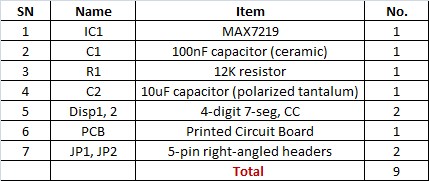
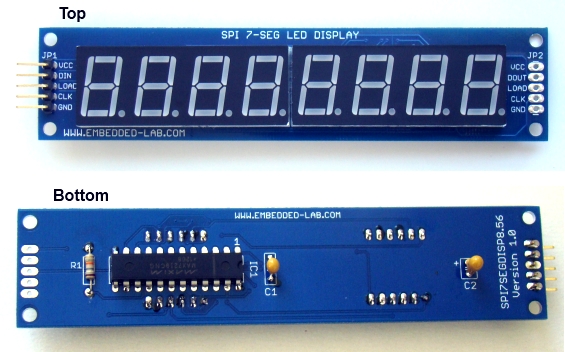
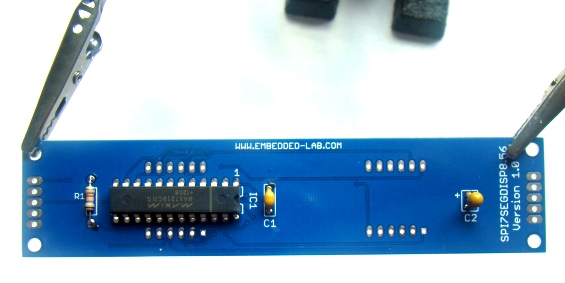
SPI7SEGDISP8.56 is a MAX7219 based serial 8-digit seven segment LED display module. With this display module, you can easily add 8 digits of seven segment LED displays to your project using only 3 I/O pins, and provides full control of all the digit segments including decimal points. You can even cascade two or more of these modules together without sacrificing any extra I/O pin. You can buy SPI7SEGDISP8.56 display kit on Tindie for only $12.00. SPI7SEGDISP8.56 PCB is double layer. The top layer consists of two 4-digit CC LED display modules (Disp1 and Disp2) arranged in a row and header connectors (JP1 and JP2), whereas the bottom layer is one where the MAX7219 chip and other passive components reside.

Assembled SPI7SEGDISP8.56 board top and bottom view

Read more

Introducing a new serial (SPI) 8-digit seven segment LED display module using MAX7219

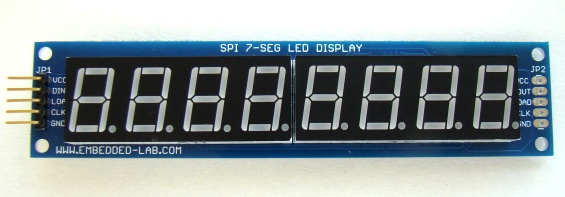
Seven segment LED displays are brighter, more attractive and provide a far viewing distance as well as a wider viewing angle as compared to LCD displays. The major drawback of using seven segment LEDs is they are resource-hungry. Time-division multiplexing is the most common technique of interfacing 7-segment LEDs to microcontrollers. With this technique, an 8-digit seven segment LED display with the decimal point requires at list 16 I/O pins of the microcontroller, which is quite a lot. Consequently, their use with low pin-count microcontrollers (such as PIC12F series) is not practically feasible. Here’s our latest version of the MAX7219 based serial seven segment LED display module (SPI7SEGDISP8.56) that will allow you to add 8 digits of seven segment LED displays to your project using only 3 I/O pins, and provides full control of all the digit segments including decimal points. You can even cascade two or more of these modules together without sacrificing any extra I/O pin. SPI7SEGDISP8.56 display kit is also available for purchase on Tindie for $12.99.

SPI7SEGDISP8.56: 8-digit serial seven segment LED display

Read more

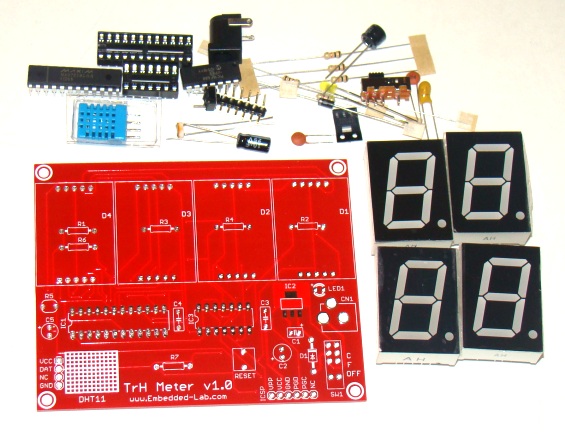
Support us by preordering TrH Meter kit on Tindie

We are now accepting pre-orders for the TrH Meter kit through Tindie’s fundraising program, a new feature that they announced a couple days ago. Our target is to receive 20 orders by Dec 31st. So if you pre-order it now, you will get a complete TrH Meter kit for a discounted price of $25 and a thank you note from us for your support in making this funding campaign successful. You will receive a preprogrammed PIC16F688 microcontroller with the kit, which means the kit is ready to go right out of the box.
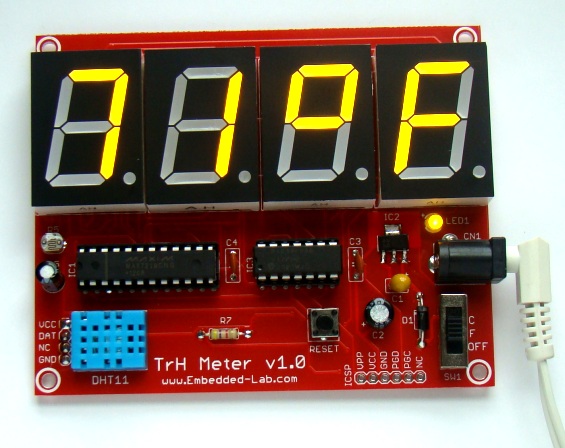
Assembled TrH Meter

“TrH Meter is a DIY microcontroller-based indoor thermometer plus hygrometer that displays temperature (F/C) and relative humidity on 4 seven segment LED displays which adjust their brightness level according to the surrounding illumination. The displays are 1 inch big, emits bright yellow color, and are readable from more than 50 ft away. It consists of a closed loop system that continuously assesses ambient light condition using an inexpensive light-dependent resistor (LDR) and uses that information to adjust the brightness of the display. The DHT11 sensor is used to measure temperature and relative humidity. The microcontroller used in this project is PIC16F688, and it runs at 4 MHz internal clock. A separate display driver chip (MAX7219) is used to control and refresh the display data on the seven segment LEDs. A 3-position slide switch controls power ON/OFF and Fahrenheit (F) or Celsius (C) scale select for temperature display.”
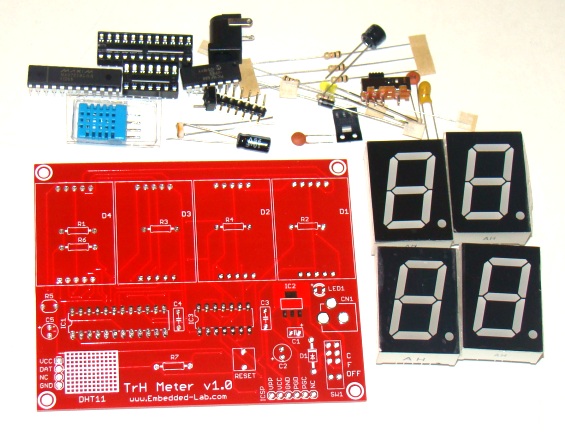
TrH Meter kit for only $25
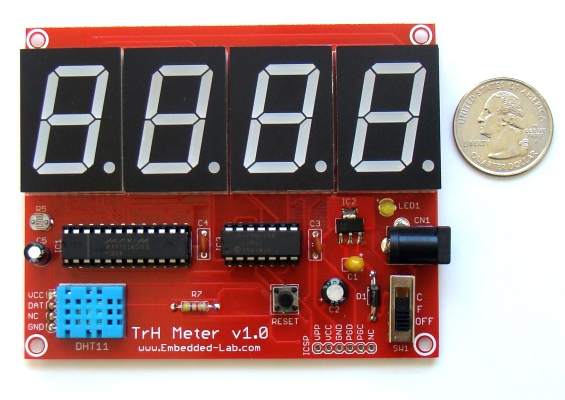
Board dimensions are approximately 3.9" X 3.1" (10cm x 8cm)

Support us by pre-ordering a TrH Meter kit here: TrH Meter kit Preorder Link
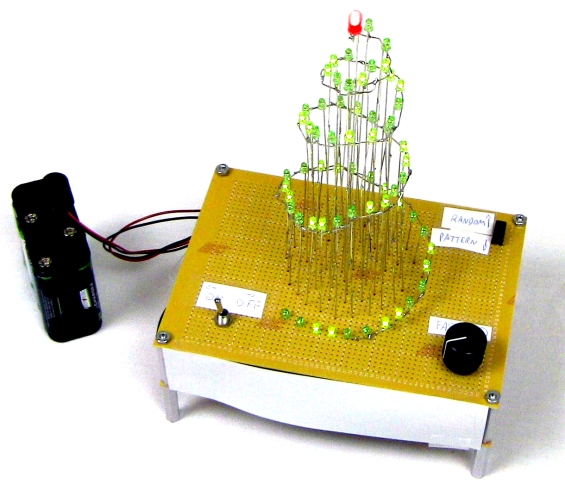
Fancy LED Christmas Tree

Chris from PyroElectro has posted a tutorial on creating an LED Christmas tree controlled entirely by digital logic. His Christmas tree is cone shaped where 64 LEDs spiral around it from top to bottom. Each LED is individually controllable through a 74HC595 shift register output. The clock for shift register is generated using 555 timer IC. The LED Christmas tree can display two types of patters, one is more predictable and another random.

LED Christmas tree

Chris is also running a fund raising campaign on Kickstarter to get support for launching a free online Digital Electronics course. For past few years Chris has been working dedicatedly towards educating people about different aspects of electronics including microcontrollers, FPGA, RF, robotics, etc by providing free online resources on his website (www.PyroElectro.com). His tutorials are mostly learning-by-doing type where he actually build things first to illustrate the concepts. Only 3 days are left for his campaign to end; if you would like to support his efforts, here’s the link to his Kickstarter campaign:

http://www.kickstarter.com/projects/pyroelectro/open-education-an-introduction-to-digital-electron

« Older Entries Recent Entries »