Author Archives: R-B

TrH Meter: A DIY indoor thermometer plus hygrometer with adaptive brightness control implemented to 7-segment LED displays
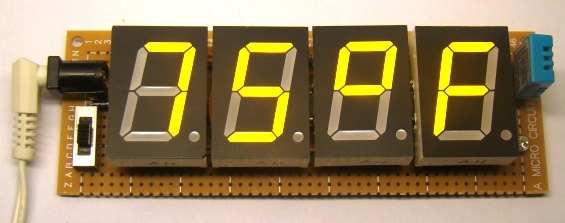
This project is about building a microcontroller-based digital room thermometer plus hygrometer that displays temperature and relative humidity on 4 large (1 inch) seven segment LED displays which adjust their brightness level according to the surrounding illumination. It consists of a closed loop system that continuously assesses ambient light condition using an inexpensive light-dependent resistor (LDR) and uses that information to adjust the brightness of the display. An inexpensive DHT11 sensor is used to measure temperature and relative humidity. The microcontroller used in this project is PIC16F688, and it runs at 4 MHz clock generated from its internal source. A separate display driver chip (MAX7219) is used to control and refresh the display data on the seven segment LEDs.
TrH Meter: A DIY indoor thermometer plus hygrometer
Read more

More PIC16F628A/PIC16F84A/PIC16F88/PIC16F1847 breakout board kits are available on Tindie

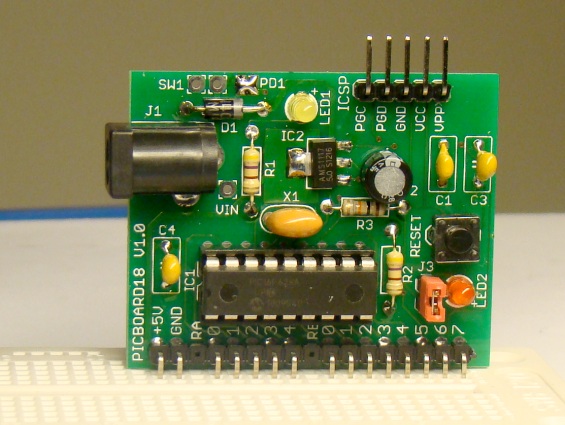
The 18-pin PIC16F series microcontrollers are still very popular among hobbyists and beginners because of their compact size, low cost, and simplicity. The PIC16F1847 is the latest release in this series and is equipped with lot more peripherals and enhanced features than its predecessors. This breakout board provides all the basic elements that are required to get you going with your next project using PIC16F1847 or its predecessors, including PIC16F628A, PIC16F88, PIC16F84A, and PIC16F1827. More details of this board are found here: http://embedded-lab.com/blog/?p=5625

PIC16F1847 breakout board

You can buy the breakout board kit with one PIC16F1847 microcontroller included for $13.00. Here’s the buying link on Tindie: PIC16F1847 breakout board

The key features of PIC16F1847 microcontroller are summarized here.

  • Enhanced Mid-range Core with 49 Instruction, 16 Stack Levels
  • 14 KB of Flash Program Memory with self read/write capability, 1KB of RAM, 256 bytes of EEPROM
  • Internal 32MHz oscillator
  • Integrated Capacitive mTouch Sensing Module
  • Data Signal Modulator Module
  • MI2C, SPI, EUSART w/auto baud
  • 2 ECCP & 2 CCP (Enhanced/Capture Compare PWM)
  • Comparators with selectable Voltage Reference
  • 12 Channel 10b ADC with internal Fixed Voltage Reference
  • 25mA Source/Sink current I/O
  • Four 8-bit Timers (TMR0/TMR2/TMR4/TMR6)
  • One 16-bit Timer (TMR1)
  • Extended Watchdog Timer (EWDT)
  • Enhanced Power-On/Off-Reset
  • Brown-Out Reset (BOR)
  • In Circuit Serial Programming (ICSP)
  • On Board In-Circuit Debug
  • Wide Operating Voltage (1.8V – 5.5V)
  • Low Power PIC16LF182x/4x variants (1.8V – 3.6V)
  • Standby Current (PIC16LF1847): 30 nA @ 1.8V, typical


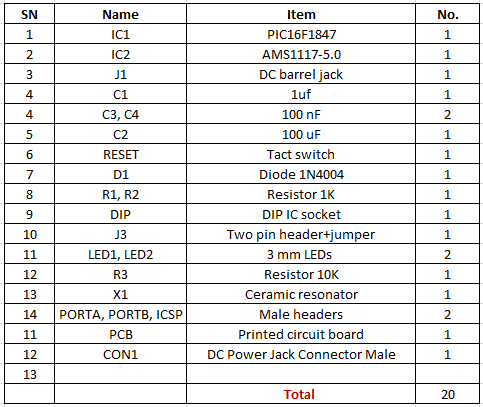
List of components inside the kit


More SPI 4-digit seven segment LED displays are available

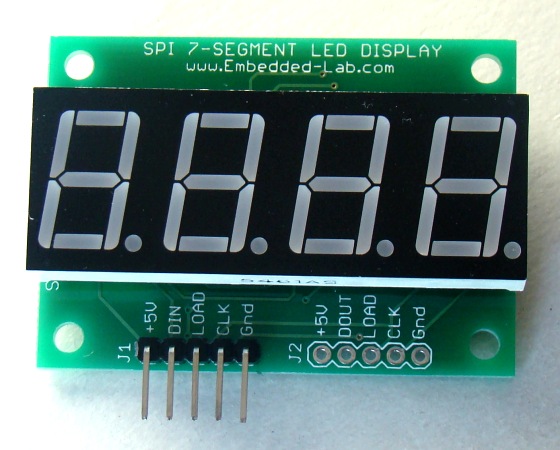
Four digit SPI 7-segment LED displays are back in stock now on Tindie. The board has been revised from its earlier version and now contains an additional header connector to cascade multiple displays. The new header provides access to DOUT pin of MAX7219 driver IC. If you want to add a seven segment LED display to your project without giving up too many I/O resources, this board allows you to do that using only 3 I/O pins and it costs only $10.

Assembled board

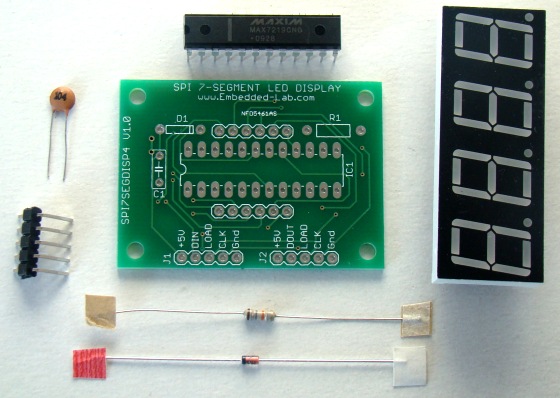
SPI 7-segment LED display kit is only $10

Tindie buying link for SPI 4-digit seven segment LED display


USB keyboard turns into an AVR programmer

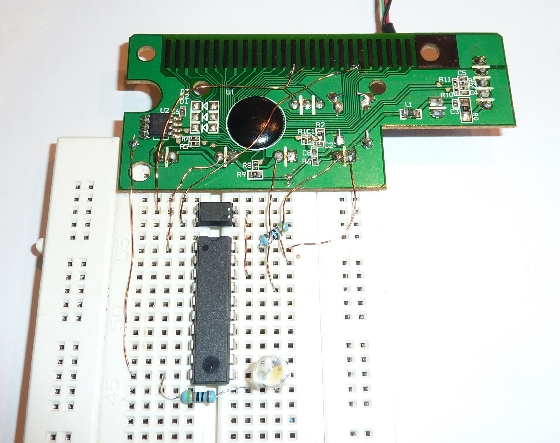
If you have an old USB keyboard that is just laying around and not usable anymore, you might consider converting it into an AVR programmer. This project from Steve is about constructing an AVR programmer using an USB keyboard controller board and an optocoupler.

USB keyboard controller turned into an AVR programmer


Steve writes,

“Most keyboards have at least three indicator LEDs (Num-, Caps- and Scroll-Lock), which can be controlled from the host using a HID Set_Report request, and thus can be used as general purpose outputs. The inputs are a bit more tricky, since the keyboard uses a scan matrix divided in rows and columns. Most keyboards also do some debouncing and detect rows that are ‘stuck’, which means that we need to simulate the keypress of a single key. If a key has been pressed, the keyboard triggers an interrupt transfer with 8 bytes of data, containing the current state of all keys. The first byte reflects the state of the modifier keys (shift, ctrl, alt, etc.) which I’ll be using as inputs. Additionally, the keys can be polled using a Get_Report request to the control endpoint, but the interrupt transfers need to be handled either way, since my keyboard just locked up after the first keypress when I didn’t handle them first.”

Read More–>

New Easy Pulse boards with red solder mask

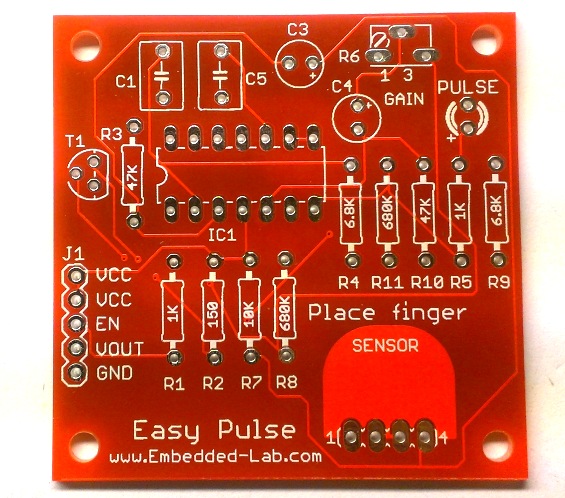
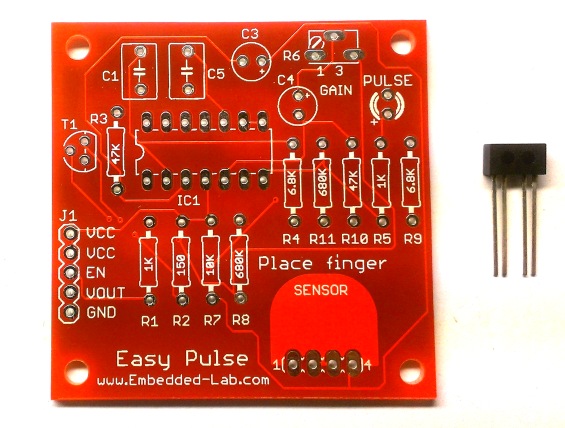
New Easy Pulse PCB boards are now available with red solder mask. You can buy PCB only for $5.00, PCB+TCRT1000 sensor for $7.00, or complete Easy Pulse kit for ($15.50), and are available on Tindie.

Easy Pulse board PCB ($5.00)

Tindie link: Buy PCB only

PCB+TCRT1000 sensor ($7.00)

Tindie link: Buy PCB+TCRT1000

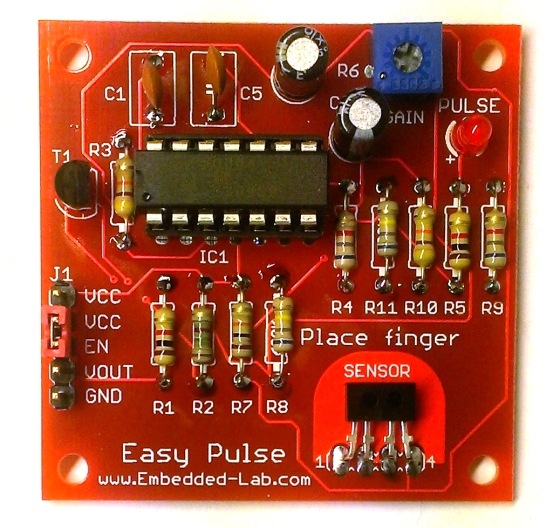
If you buy a full kit you will receive all the parts to assemble the board, which will look like as shown below.

Complete kit for $15.50

Tindie link: Buy complete kit

Easy Pulse board provides a reflective IR sensor with necessary instrumentation circuit to illustrate the principle of photoplethysmography as a noninvasive technique for measuring heart rate. It uses the TCRT1000 reflective optical sensor to sense the blood variation in the finger tissue and outputs a digital pulse which is synchronous with the heart beat. The output pulse can be fed to either an ADC channel or a digital input pin of a microcontroller for further processing and retrieving the heart rate in beats per minute (BPM). You can find more details at

http://embedded-lab.com/blog/?p=5508

« Older Entries Recent Entries »