Author Archives: R-B

MikroC Pro for PIC : Installation and Setup
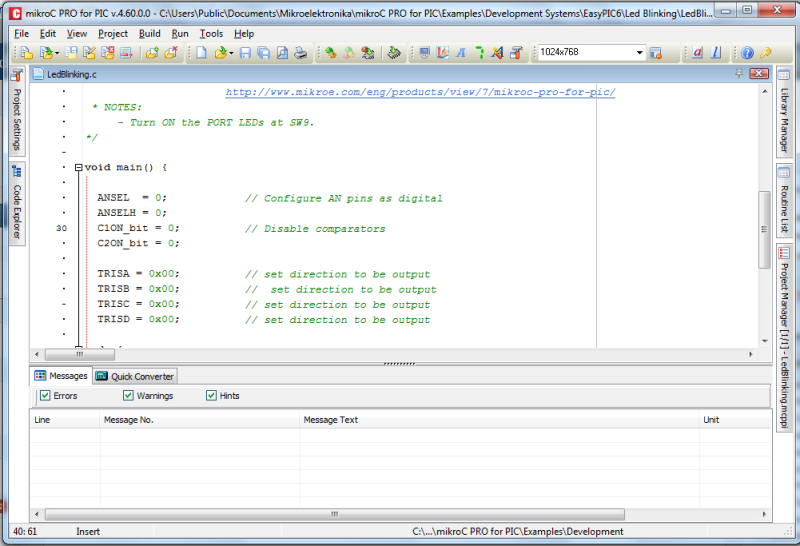
My PIC tutorials and projects use MikroC compiler for firmware development. But I don’t think I ever posted anything on its installation and setup. Today, I am going to show how to install MikroC Pro for PIC (v4.60) on a Windows PC. First of all, download the zipped installation file from here, unzip it and run the setup program. Installation is straightforward. When you first start the MikroC compiler, it opens a LED blinking example project. You can close this project by clicking on ‘Close Project’ under Project menu. Read more
Open source color video game development system based on AVR

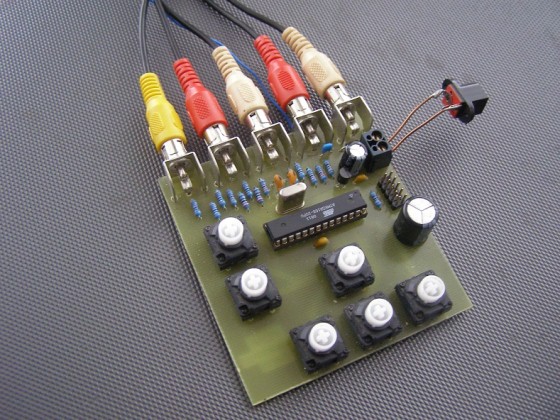
This project describes an open source color game development platform based on an AVR microcontroller. You can code a color, high resolution, smooth video game, like Super Mario Bros or Commander Keen on this system. All video processing is done by software in background using interrupts, with no external active components. You only need to connect the AVR to a RGB monitor. AVRs don’t have enough RAM for direct video memory, and therefore a TILE based graphics driver is used. In TILE, the display screen is divided into X*Y tiles and each tile graphic is addressed from reference table located in RAM, whereas the true bitmaps are stored somewhere else, in a ROM for example.

“The AVGA instantly turns any Mega AVR to a powerful game console.”

Read more

A contact-less digital tachometer based on optical sensors

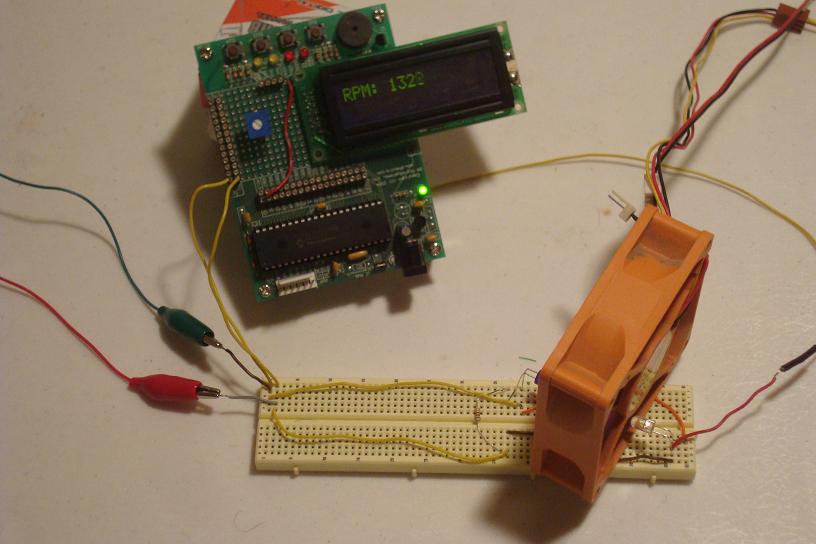
A tachometer is use to measure the rotations per minute (RPM) of a moving shaft or a motor. An example is a digital tachometer in a car that gives the RPM of the engine. This tutorial shows how to build a digital tachometer using a microcontroller and optical sensors.

The sensor unit consists of an IR LED that transmits infrared light and a photo diode that receives the light. This project uses a computer fan to demonstrate the technique. The fan is placed between the IR LED and the photo diode so that the blades of the moving fan interrupts the light received by the photo diode. Each interruption of the light gives a pulse that is counted by a PIC18F452 microcontroller. With a little math, the number of rotations per minute can be calculated. The result is displayed on a LCD screen. Read more

Digital alarm clock using PIC

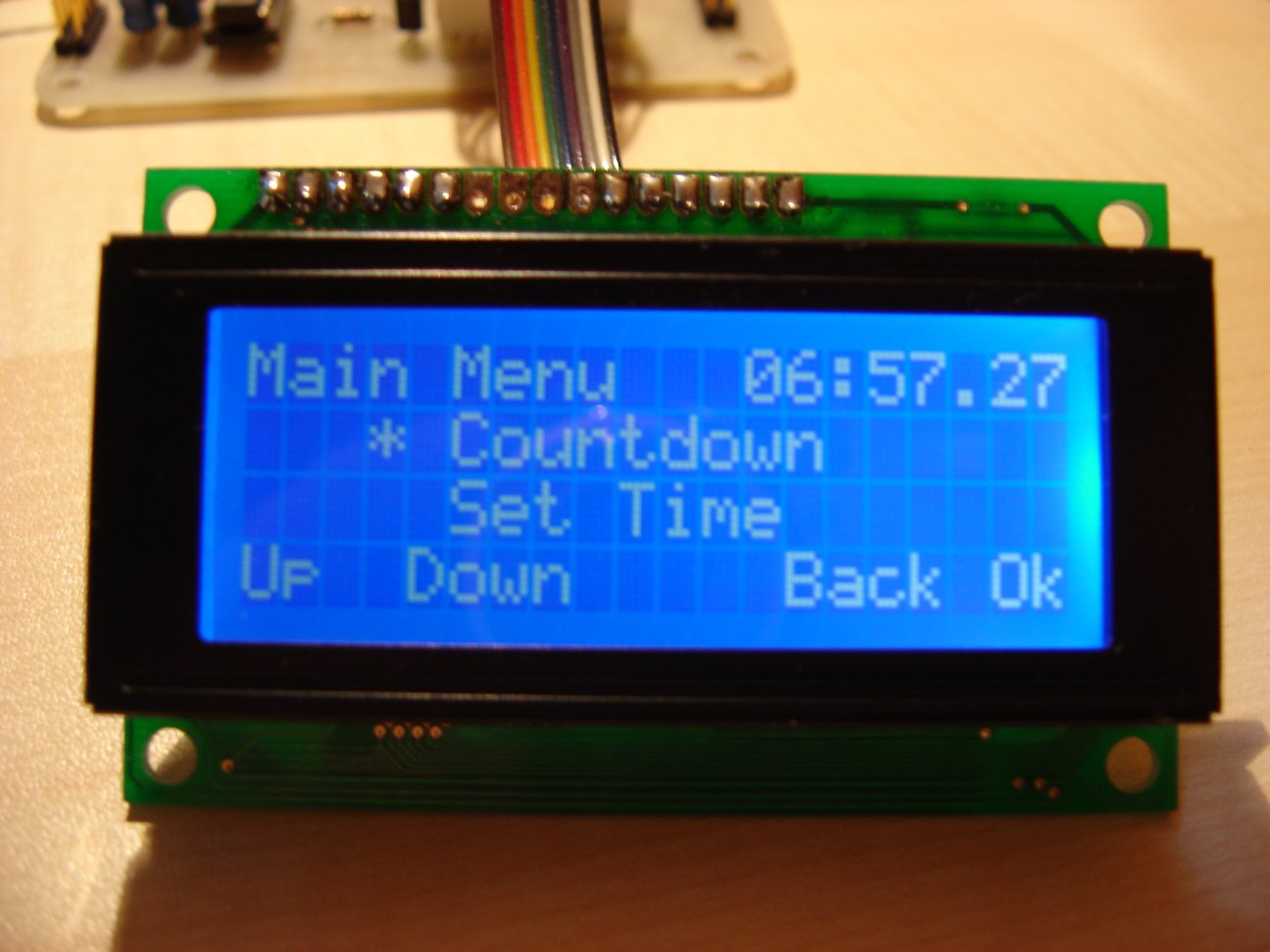
This project describes a digital clock with alarm function. It uses a PIC16F877 microcontroller to generate an accurate 1 sec delay with Timer0 using Roman’s zero error method. The time is displayed in large size font on a 4×20 character LCD that uses HD44780 display driver. You can synchronize the time with your computer time through a serial port.

The required power is provided through a 9 V wall adapter which is used to obtain a regulated +5 V power supply using a LM7805 IC. The microcontroller runs with a 20 MHz external clock. The backlight of LCD is driven by a PWM output from the microcontroller so that the back light intensity can be varied. The full software written in JAL is available to download.

Read more

Arduino: Digital energy monitor for your house

This project describes a whole house energy monitor that provides quick access to current energy use information, usb datalogging for detailed long term data storage and Internet connectivity for online graphing.

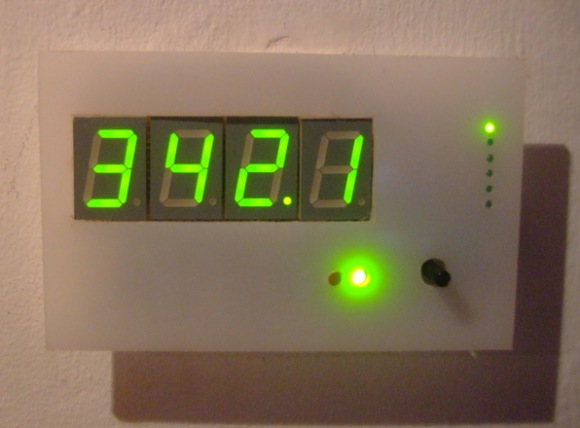
The display unit uses four seven-segment LED displays that shows real power, apparent power, power factor, RMS voltage, RMS current, frequency and cumulative KWH consumed.

Read more

« Older Entries Recent Entries »