Author Archives: R-B

Arduino: 24 hours digital clock

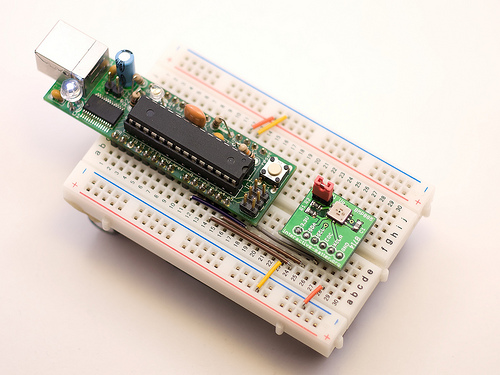
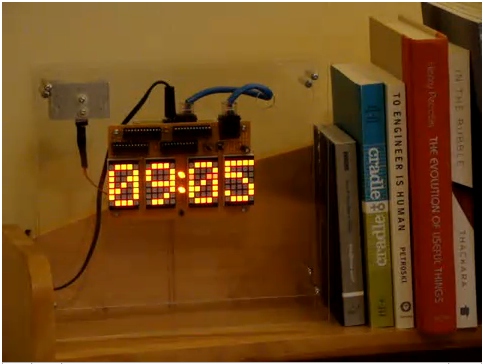
This is an Arduino powered 24-hour digital clock that uses the RTC chip DS1307 for timekeeping. DS1307 has a small battery backup so that it keeps the correct time even the rest of the circuit is not powered. The time is displayed on 5×7 LED dot matrix.

The ATMEGA168 controller and the rest of the circuit is powered by a 9 volt 650 mA power supply with a LM7805 regulator IC.

Read more

Interface a barometric pressure sensor with Arduino

This tutorial describes how to use a pressure sensor with an Arduino board. The sensor used is BMP085, which is a high-precision, ultra-low power barometric pressure sensor for use in advanced mobile applications. It offers superior performance with an absolute accuracy of down to 0.03 hPa and using very low power consumption down to 3 µA. The BMP08 accepts 1.8 to 3.6 Volts and supports I2C interface.

Read more

AVR: self-monitoring its own power supply

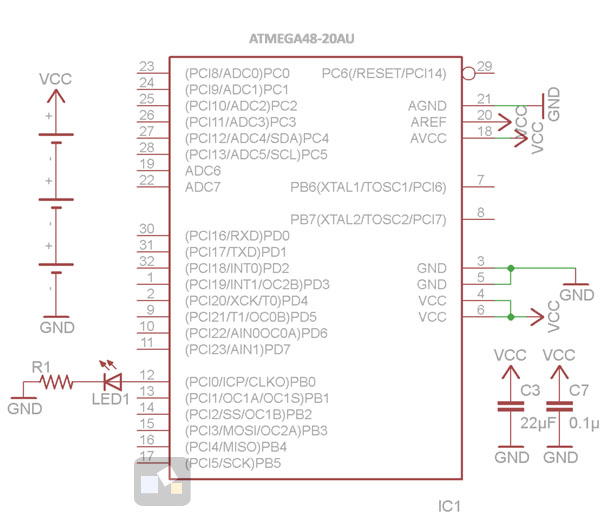
How would a microcontroller know how it’s own supply voltage is changing? Well, most microcontrollers have built in analog-to-digital converters that can read an input analog voltage and convert it to a digital number. So, it might be suggestive to use a similar technique. But the problem is, any ADC operation requires a reference voltage, which in most cases, is either the source voltage or one derived from it. So, how would you monitor the source voltage through ADC that uses the same source voltage as reference?
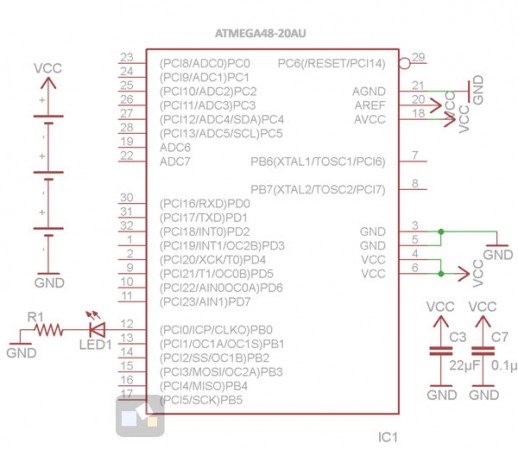
The following article describes a way to do this without using any additional external components. It uses the internal band gap reference voltage of an AVR microcontroller to correct any error in the measurement of the supply voltage through the built in ADC. The band gap voltage of AVR is fixed 1.1 V that you can feed to ADC input using software. You know what would be the ADC output for this fixed band gap input voltage, with the known supply voltage as reference. If you find any drift in the measurement output, you can calculate the drift in the reference voltage, and so in the supply voltage.
Read

Radio link between two Arduino boards

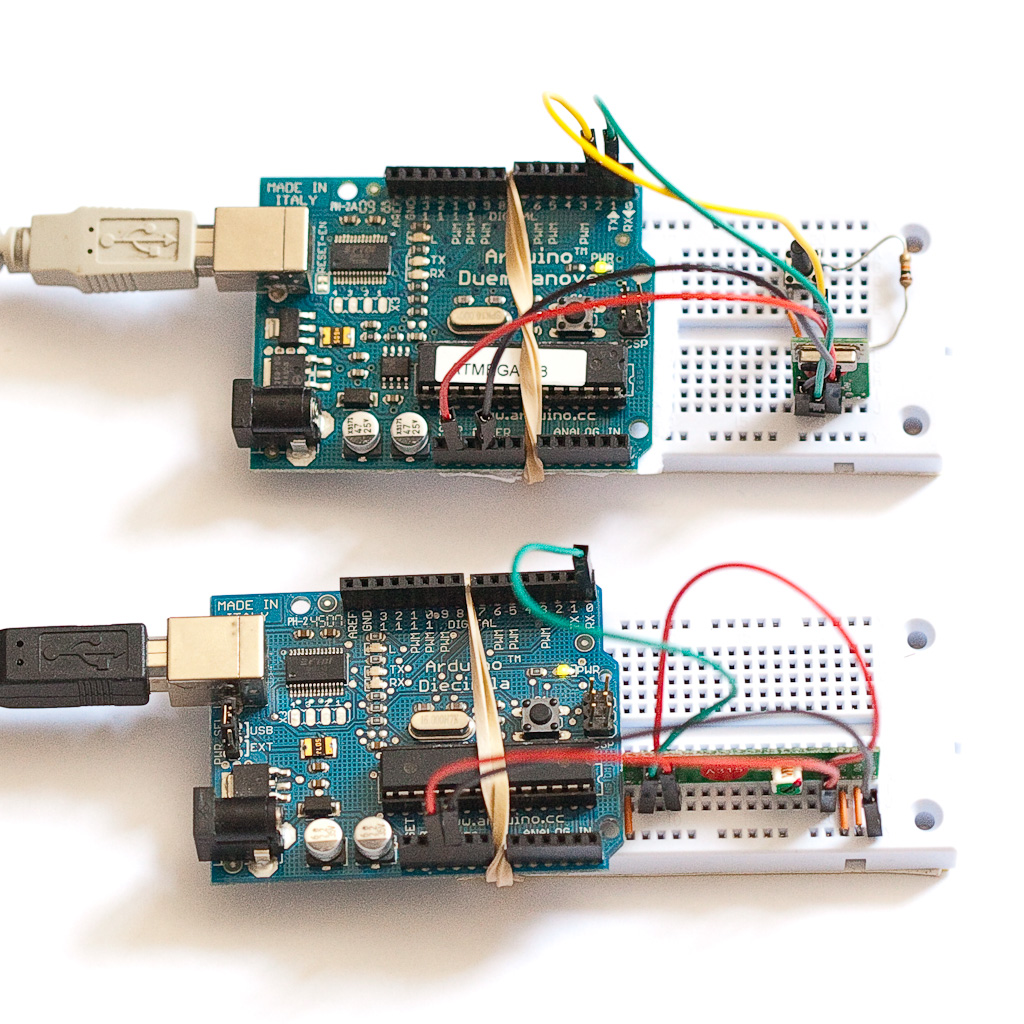
If you are looking  a wireless communication between two Arduino modules, this project might be helpful. It uses low costs RF transmitter and receiver from Sparkfun to establish a radio link between the Arduino boards up to 500 ft. Data can be transferred serially at the maximum rate of 2400 bps.

The author provides details on hardware and application software.

Read more

Arduino-Python based multiple servo control

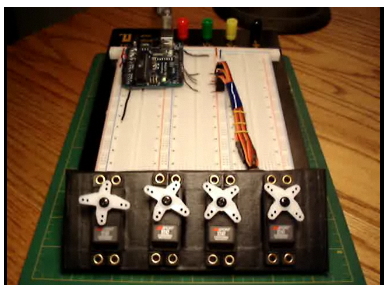
This tutorial describes how to control multiple servos with an Arduino module interfaced to a PC through serial port. The application program on the PC is written in Python script that gives control commands to the Arduino module. The Arduino module receives the commands through its serial input and then moves each servo to its commanded position.

The hardware part consists of an Arduino module, four JR Sport ST47 standard servos, and a breadboard to prototype the circuit.

Read more

« Older Entries Recent Entries »