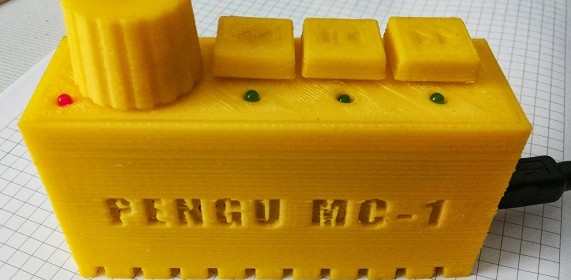
Enhancing audio with echo effect

Delay effects are commonly implemented in various audio systems including Karaoke player, guitar amplifier, advanced sound processing equipment, recording studios, television etc. It basically adds an echo to the original audio by repeating the audio after a specified amount of time. Rajkumar Sharma’s new project is about building an echo generator using Holtek’s HT8970 IC, which is an echo/surround effect processor with built-in pre-amplifier, VCO, 20Kb SRAM, A/D and D/A converters as well as delay time control logic. With all these functions built inside the chip, you can easily enhance your audio with an echo effect using a minimal number of external components.  

Read more

Access 15 tact switches with one input pin
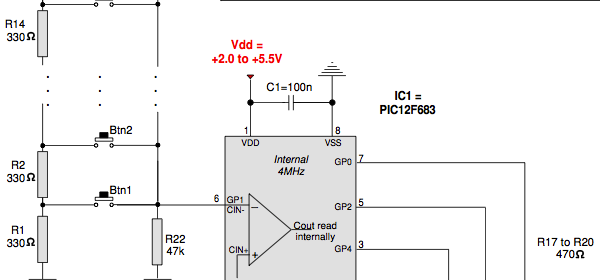
A while back I posted two articles on reading multiple tact switches using a minimal number of I/O pins of PIC microcontroller. One of them uses a resistor-divider network to create an unique range of analog voltages for each keypress. The voltage is then measured through an ADC input channel to detect which key has been pressed. Another approach was a 2-wire keypad interface using 555 timer IC configured as an astable multivibrator. The 555 timer is configured to generate a specific frequency of oscillation for each key press. However, these are not the only methods out there. Benabadji Noureddine’s recent

Read more

Underwear alarm

Last week we looked at Randy’s walking robot made of customized 3-D printed parts. This week, he came up with this crazy idea of making underwear wake-up alarm for his lazy girl friend, who does not wake up with alarm clocks. His new project, Goodmorning Underwear, is built using the littleBits prototyping platform and a pair of panties, which vibrates to wake you up in the morning. The event to trigger the alarm are set up through Google Calender. Two vibration motors embedded into the underwear set off a gentle buzz to remind you of the event.

Read more

ChronodeVFD: A wearable wrist watch with vacuum fluorescent display

Vacuum Fluorescent Displays (VFD) are usually considered bulky, and are, therefore, mostly found in non-portable consumer-electronics gadgets such as DVD players, automobile audio system, and electric ranges. Johngineer’s ChronodeVFD is an exception to that. He used them to construct a wearable wrist watch. The ChronodeVFD uses the IVL2-7/5 VFD display tube controlled by the Maxim MAX6920 chip, which is a 12-bit output, 76V, vacuum fluorescent display (VFD) tube driver. The core of the project is the ATMega88 microcontroller and the DS3231 RTC chip. His design also includes an analog light sensor, a BMP180 barometric/temperature sensor and a MMA8653 accelerometer. The finished watch is powered by

Read more

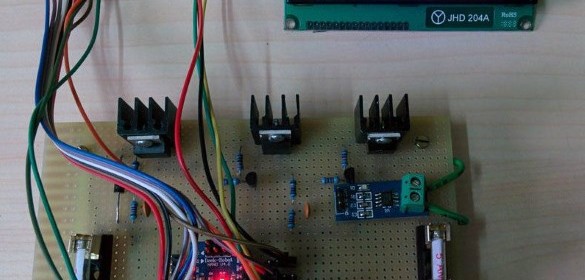
Arduino solar charge controller and energy monitor

Solar charge controller is a key component in any photovoltaic system that uses batteries to store energy. The main function of solar charge controller it to reduce the overall system maintenance and prolongs the battery life by regulating the charging voltage and current coming from the solar panels. It also protects the battery from both overcharging and deep discharging. Today, most of the solar charge controllers utilize the Pulse Width Modulation (PWM) technique to adjust the charging voltage and current according to the charging status of the batteries. For instance, if the battery gets closer to fully-charged condition, the amount

Read more
« Older Entries Recent Entries »