Voltage monitor for car’s battery and its charging system
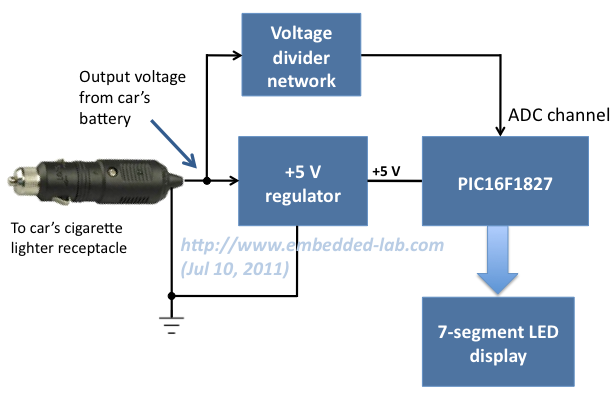
My 2010 Equinox has got every feature that a modern automobile should have. However, one thing that I personally find missing is the real-time monitoring of voltage across the car’s battery terminals. This may not seem to be that important but one of the most common reasons for a car battery failure is the faulty charging system. If the charging system is not working properly, the battery will not get the proper charging voltage (about 13.8 V for 12V battery) across its terminals and it could go flat. This project is about making a simple electronic voltage monitor system for

Read more
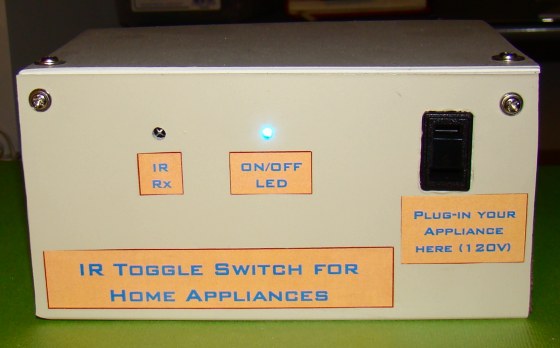
A very simple IR remote control switch for an electrical appliance

This project describes a technique of adding the remote control feature to an electrical appliance. The goal is to construct a black box where you can plug-in your 120V AC appliance (it can be easily modified for 220 V mains supply too) and control the ON and OFF operations with a TV or DVD remote that uses modulated infra-red (IR) pulse train of 38 KHz frequency. I did this project for my wife who studies late at night on her bed and later feels tired to stand up and turns the light off. Now she does it from bed with

Read more

Using Fixed Voltage Reference (FVR) for A/D conversion in enhanced mid-range PIC microcontrollers

The reference voltage plays a very important role in any A/D conversion. It determines both the range and the resolution (Volt/Count) of the A/D conversion. Besides, the accuracy of the conversion also depends upon how stable the reference voltage is. Usually in PIC microcontrollers, the reference voltage for A/D conversion can be selected as the supply voltage itself or provided externally through one or more I/O pins. But the new enhanced mid-range family of 8-bit PIC microcontrollers have a built-in module that generates a stable reference voltage internally. It is called Fixed Voltage Reference (FVR) where the output is very

Read more

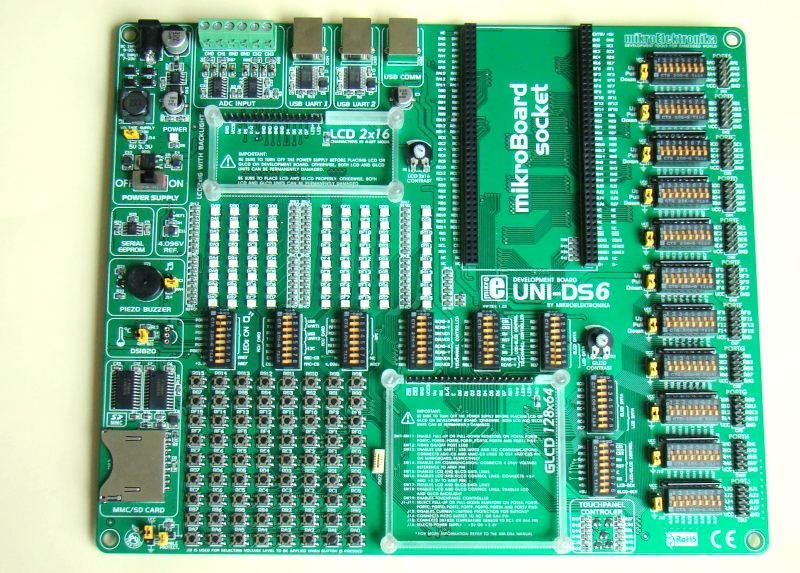
UNI-DS6 development board for experimenting with dsPIC30F6014A

UNI-DS6 is an universal development board from mikroElektronika for experimenting with a wide range of microcontrollers including PIC, AVR, dsPIC, ARM, and 8051. I am going to use this board to educate myself about Microchip’s dsPIC Digital Signal Controllers (DSCs). The dsPIC DSCs are 16-bit high performance microcontrollers and more powerful than regular PIC devices. They are special because they combine the best features of microcontrollers with the computational capabilities of a Digital Signal Processor (DSP), and they are capable of doing complex mathematical operations involving Fourier transforms. I am going to describe briefly about the features of UNI-DS6 board

Read more

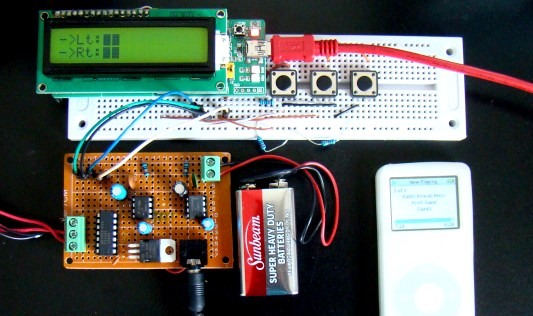
LM386 based stereo audio amplifier with digital volume control

Due to its simplicity (requires minimum external components) and high availability, LM386 is very popular among hobbyists for use in low-voltage audio amplification applications. Most of the time a potentiometer is used at the input side of LM386 to provide a volume control in the outputĀ speaker. The potentiometer does not control the gain of the amplifier itself, but it creates a voltage divider network at the input, which in fact controls the fraction of the audio signal that is fed to the amplifier. This project is about a stereo audio amplifier using two LM386 ICs with digital volume controlĀ for both

Read more
« Older Entries Recent Entries »