Automatic candy sorter
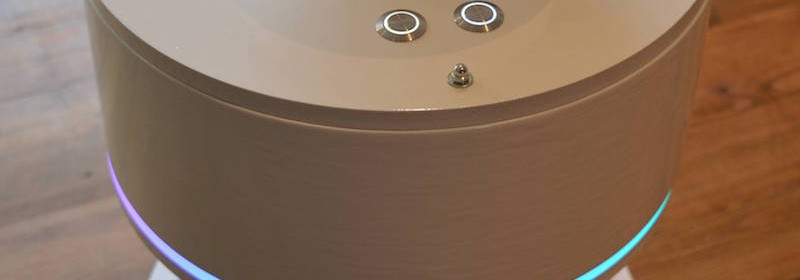
Built by Willem Pennings from the Netherlands, this color candy sorting machine is robust and beautifully designed. It uses an Arduino controller, stepper motors, an RGB color sensor and several 3D-printed parts to perform sorting of colorful candies like M&M and Skittles. It can sort a 300 gram bag of mixed M&M in approximately 2-3 minutes. Posted below is a video showing the machine in action. The machine is able to sort M&M’s and Skittles by colour by performing optical measurements using the RGB sensor. It can be modified to sort any type of coloured object, as long as the individual pieces

Read more
Tutorial 8: ESP8266 Internet clock

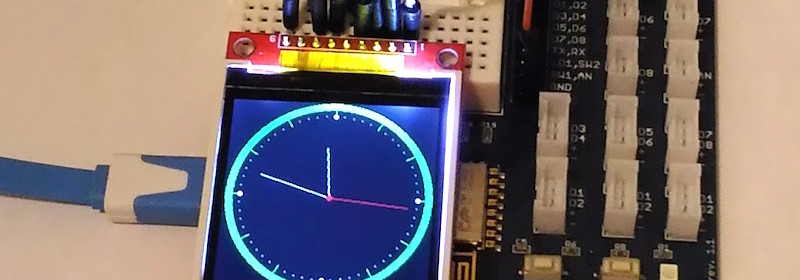
The National Institute of Standards and Technology (NIST) provides official time in the United States. NIST disseminates the time using several methods, including radio broadcasting over short-wave and long-wave frequencies, telephone dial-in services (ACTS), and Network Time Service (NTS) over the internet. This tutorial describes how to build an ESP8266-based internet clock that uses NIST’s NTS service to retrieve accurate time information. The time is displayed on a colorful TFT LCD (ILI9341 driven) in both analog clock dial and digital formats. The time is synchronized to the NIST server in every 2-minute interval. Hardware This project uses an ESP8266 module to connect to

Read more

Tutorial 7: ESP8266 and ILI9341 TFT LCD

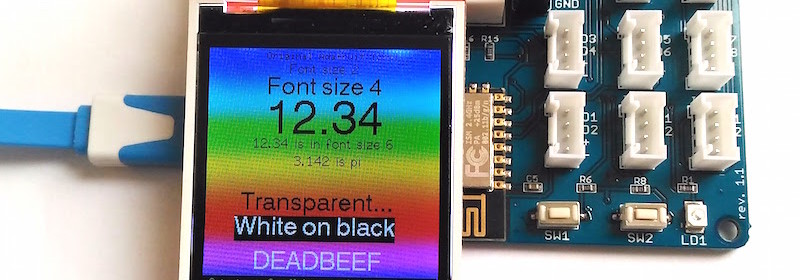
In tutorial 3, we discussed how to use an SSD1306-driven I2C OLED screen with EasyESP-1 for displaying basic text and graphics. We used a 0.96″ (along the diagonal) 128×64 monochrome pixels OLED display for illustration. Despite its small size, the readability was pretty good due to its high contrast, which makes it a very good, compact size display for general applications. The excitement of having a display screen in an ESP8266 project can be further enhanced by upgrading the choice of display to colorful TFT LCD. One such screen that is readily available in the market at affordable price is ILI9341

Read more

Animated IoT clock that can’t be trusted

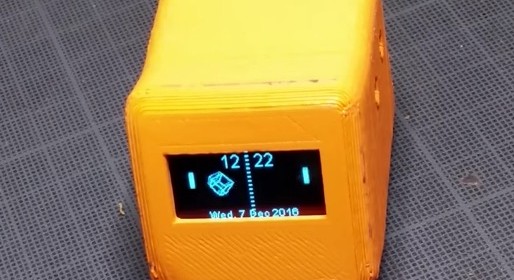
An animated IoT clock shared by Tobozo Tagada does not use any RTC module orconnect to a NTP server to retrieve the time. It rather scans the open WiFi access points in its surrounding and extract the date/time from the “Date” HTTP header, if sent out by some. Trust this clock’s accuracy at your own risk. It uses WeMOS ESP8266 board and an OLED screen to display the time along with a pong animation in the background to “cut on the boringness of the clock”, as he said. Expecting unknown networks to provide a HTTP header value and relying on it to estimate time

Read more

WiFi deauthentication attacker using ESP8266

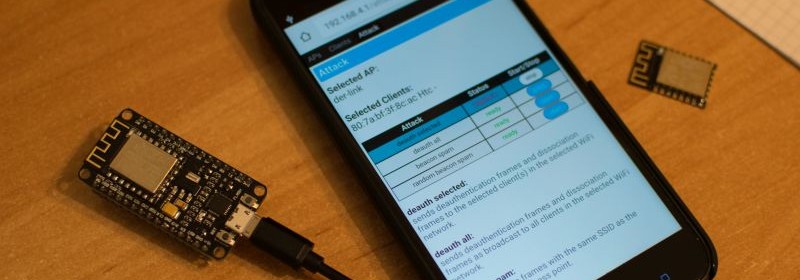
The IEEE 802.11 (Wi-Fi) protocol contains a so-called deauthentication frame that are used as management frames to disconnect the links between stations and access points. Because management frames are often unencrypted, it is fairly easy to perform deauthentication attacks using a WiFi device by spoofing the MAC address of the access point. Alternatively, it can also be done by sending deauthentication frames to the access point with a clients’ MAC address as a destination. Spacehuhn has shared his ESP8266 based implementation of a deauthentication attacker on Github. It can disconnect any client from a network by repeatedly sending fake deauthentication frames. The attacker does not

Read more
« Older Entries Recent Entries »