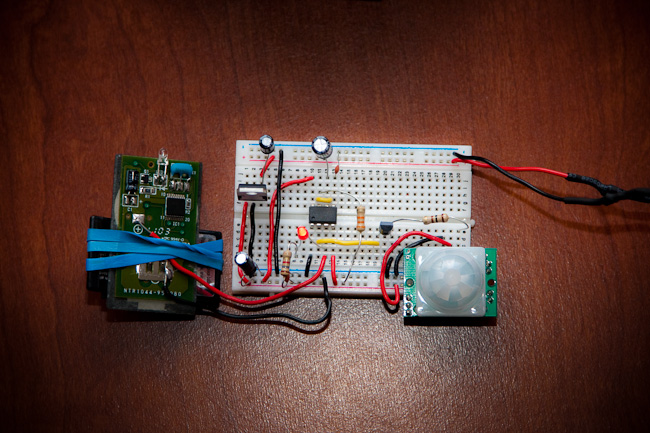
Commandments for using PIC Microcontrollers

Based on his working experience with PIC microcontrollers, John Chandler has summarized some basic rules that could minimize the project development time and increase the reliability of PIC operation. Some of these rules (he said commandments) are related to power supply, clock and reset operation and hence they are applicable to all PIC circuits. Some PIC microcontrollers have multiple pins for Vcc and ground. He suggests to connect all of them not just one pair. A 0.1 uF bypass capacitor must be connected closest to the microcontroller. Similarly, the MCLR pin must not be floating, if it is enabled. Read more

Read more
555 Contest Entry: “Whack a Mole” style game

Jim Chen made a very interesting LED chasing game that uses six 556 timer chips. This is his second entry to the 555 contest which is recently closed. There are nine LEDs in the game. Any of them could glow randomly. The player has to turn off the LED by touching an electrode next to the LED. While the player continue playing the game the time available for the player is less and less. When you missed to turn off an LED within the provided time frame, the game is over. Here’s how the game works.

Read more

How to measure dc current with a microcontroller?

Microcontrollers usually don’t have specific ports for measuring currents, but they do have ADC channels through which you can measure analog voltages of a certain range. This means a dc current can be indirectly measured by a microcontroller’s ADC channel by first converting the current into voltage. The simplest way of doing this is to place a resistance in series with the current path and measure the voltage drop across it. But hold on, if you place an additional resistance in the circuit, it will affect the original current. Therefore, we need to use a very small value resistance so

Read more
« Older Entries Recent Entries »