This energy wristband monitors energy usage at home

Matthew Venn has designed a prototype energy wristband that would tell you when there is a change in electrical energy usage at home through a a gentle vibration. The wristband also consists of a 4-LED bargraph to display the current usage. A wristband that tells you energy changes in your home. It connects via a Raspberry Pi computer to a base station like a ‘current cost’ or similar. When a change in energy usage occurs, the wristband vibrates and a small LED bargraph shows your current usage from 1 to 4. Realtime energy use can be queried by pressing the button.

Read more

Microchip is launching “Curiosity” development board
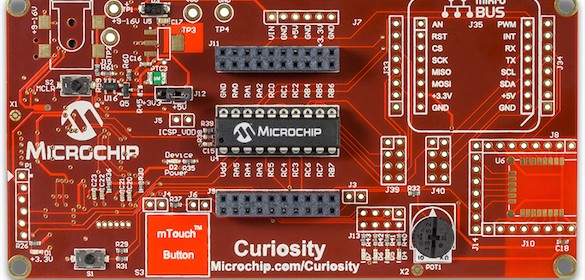
Microchip is launching a new development board called Curiosity for 8-bit PIC lovers. It supports 8-, 14-, 20-pin 8-bit PIC® Microcontrollers with low voltage programming capability and has an integrated Programmer/Debugger with USB Interface that is fully compatible with Microchip’s MPLAB X development environment. Your next embedded design idea has a new home. Curiosity is a cost-effective, fully integrated 8-bit development platform targeted at first-time users, Makers, and those seeking a feature-rich rapid prototyping board. Designed from the ground-up to take full advantage of Microchip’s MPLAB X development environment, Curiosity includes an integrated programmer/debugger, and requires no additional hardware to get started.

Read more
FPGA-controlled robot solves Rubik’s cube

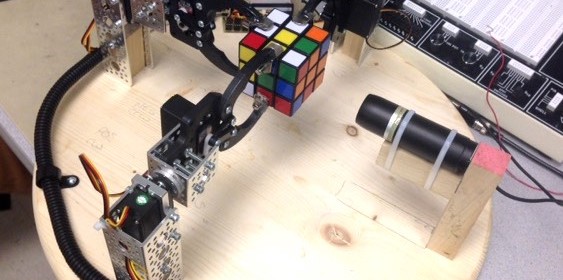
Alex Whiteway, Sungjoon Park, and Rameez Qurashi‘s final project for their ECE 5760 course at Cornell was FPGA-controlled mechanical arms to solve Rubik’s cube. While the arms rotate the cube, each cube face is scanned by a camera and the scanned data are passed into a Rubik’s cube solving algorithm, which then computes what the next moves would be towards solving the cube. The move instructions are sent to the FPGA, which in turn sends PWM signals to the servos to rotate the cube accordingly. They write, A variety of Rubik’s cube solvers (including a few FPGA implementations) have been

Read more

PIC24 Development Board

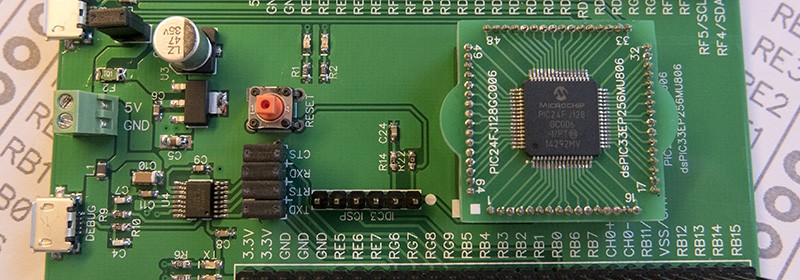
Brian Dorey shares the schematics and design files for his PIC24 Development board that works with the PIC24FJ128GC006 as well as DSPIC33EP256MU806 dsPIC series microcontrollers. The prototyping board was designed with removable daughter boards for the microcontroller.  This means that we can use several different microcontrollers on the same board and if we accidently do something that damages a part of the microcontroller it is easy to replace it without having to unsolder the chip. The PIC24FJ128GC006 includes a USB port so we added one onto the board, this will come in handy if we want to design any devices that

Read more

Return path discontinuity and EMI

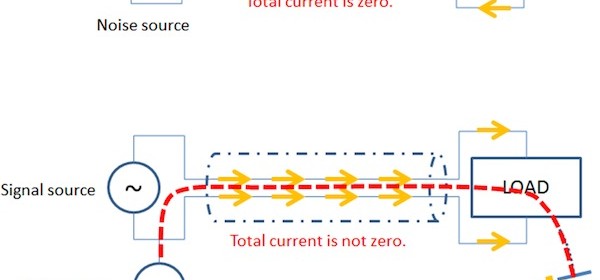
While designing PCBs for high frequency circuits, it is critical that the characteristic impedance is under control for signal integrity and minimal EMI. One of the biggest concerns in doing so is the signal path discontinuities, including the return path on ground plane. Minoru Ishikawa has posted some tips in this article on EDN to understand the relationship between the return path discontinuities and electromagnetic compatibilty, that will help to enhance the EM compatibility of your final design. It’s conventional wisdom that a solid, continuous return path provides a better result in electromagnetic compatibility (EMC). This article discusses the relationship between return

Read more
« Older Entries Recent Entries »