Author Archives: R-B

Have a 360 degree view of your PCB design online

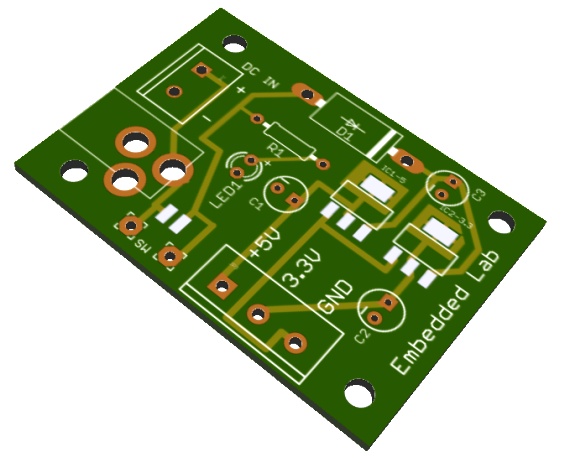
3D Gerber Viewer from Mayhew Labs is a free online application that allows you to upload gerber files and generate a 3D model of your PCB. It’s definitely a handy tool to check for any silk-screen, solder mask or other errors in your PCB design, before you send the gerber files to manufacturer.

3D Gerber Viewer's view of my dual power supply board

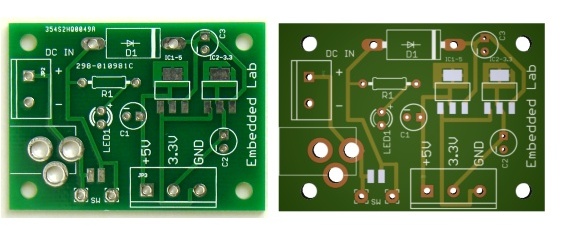
Comparison of the actual PCB (left) and the 3D Gerber Viewer output

Upload your Gerber files and have a 360 degree view of your PCB design. Pretty neat!


chipKIT Tutorial 1: Digital input and output

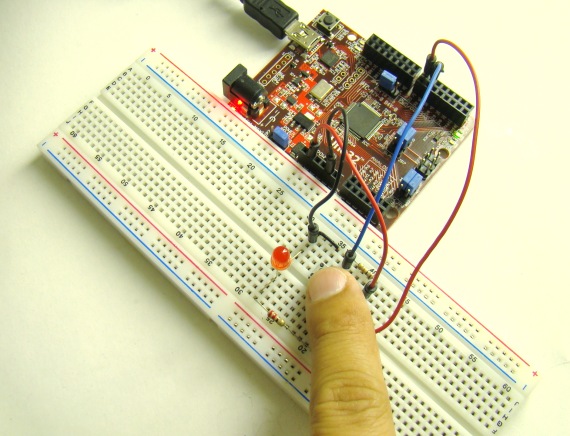
Our first chipKIT tutorial is about reading and writing digital data (0 or 1) from and to an I/O pin of the chipKIT board. Digital inputs are useful to determine whether an incoming digital signal is logic HIGH or logic LOW. A simple application of digital input is reading the state of a push-button switch and perform some action based on if the switch has been pressed or not. Similarly, digital outputs are used by microcontrollers for many purposes, such as to enable or disable an external chip, drive LEDs and LCD displays, control relay switches, etc. In this tutorial, we will build a very simple circuit using a momentary push-button and an LED, both connected to the digital I/O pins of chipKIT Uno32. The state of the switch is continuously read by Uno32, which then toggles the LED on and off every time the switch is pressed.

Digital input and output

Read more

Getting acquainted with the chipKIT programming tool

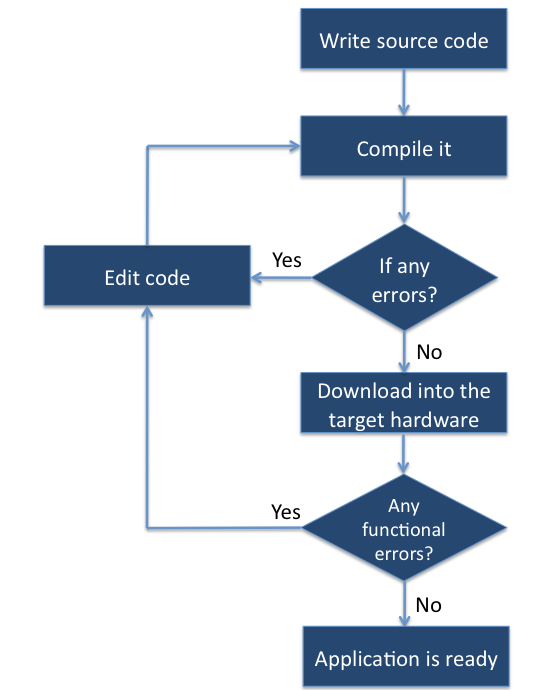
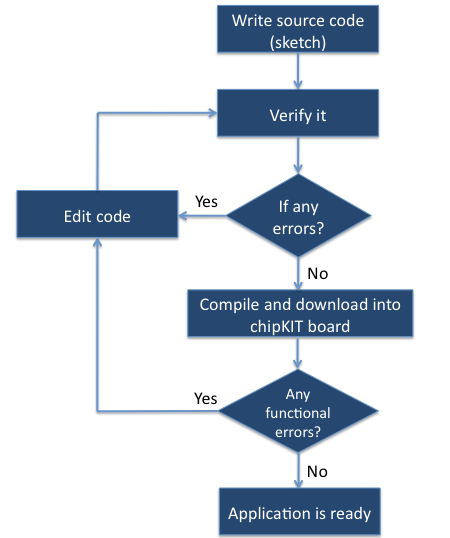
The overall process of designing a microcontroller-based system is divided into  two parts: designing the hardware of the system, and writing the control software for it. Before the design cycle begins, it is important to have good knowledge of the tools available for the chosen development platform. While we already explored the hardware features of the chipKIT UNO32 board in Exploring the chipKIT Uno32 board, it’s time to look at the software development process. The flowchart below gives an overview of how an application program is developed for the chipKIT board.

Software development process for the chipKIT board

Read more

Exploring the chipKIT Uno32 board

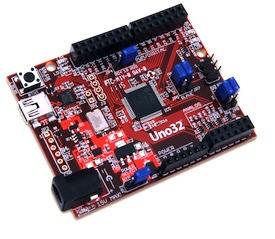
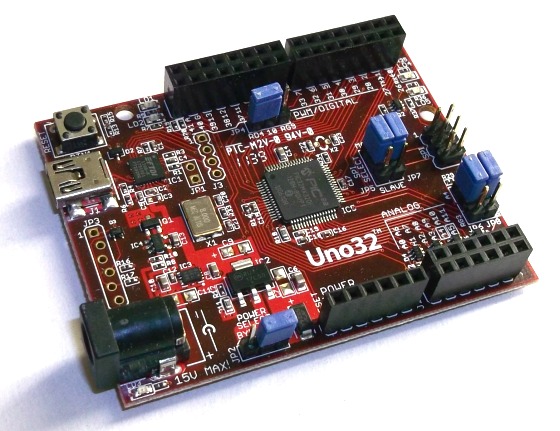
The chipKIT Uno32 development board is based on the powerful PIC32MX320F128 microcontroller, which features a 32-bit MIPS processor core running at 80MHz, 128K of flash program memory, and 16K of SRAM data memory. The board can be powered via USB or an external power supply. The on-board USB-UART interface provides a communication path between the board and the MPIDE tool running on the PC. MPIDE stands for Multi-Platform Integrated Development Environment and is a complete tool for developing and downloading embedded applications into the chipKIT Uno32 board. Now let’s explore the chipKIT Uno32 board and its on-board features in more detail.

chipKIT Uno32 board

Read more

A brief introduction to the chipKIT platform

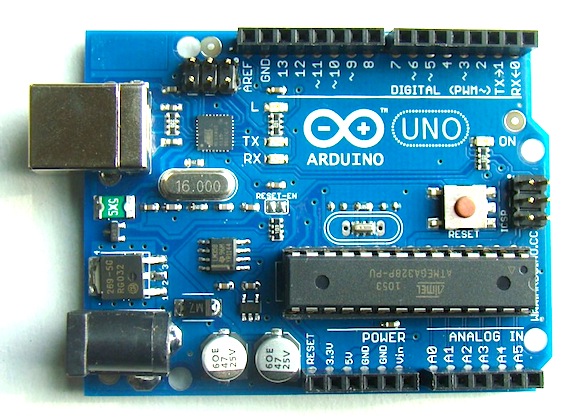
In order to understand the chipKIT platform, it is important to talk about Arduino first. Arduino is an easy-to-use and powerful open source environment for developing microcontroller based applications. It has gained huge amount of popularity in past few years, specially among hobbyists. Arduino has been a wonderful tool, introducing many people to the world of embedded electronics with little or no prior knowledge of electronics. The standard Arduino development boards are based on 8-bit Atmel AVR processors which are pre-programmed with a serial bootloader, and thus simplifies the uploading of user programs to the on-chip flash memory without the need of any external programmer. Because of its low cost, easy-to-use software development environment (open-source C/C++ like programming platform), rich set of libraries, and tons of resources available online, Arduino has become a common choice for electronics hobbyists these days. Hundreds of plug-in application boards, called Arduino shields, are also commercially available to extend the functional capabilities of the Arduino board. The simplicity and the open source nature of Arduino and its shields allow students, hobbyists, and even artists to do many creative things.

Inspired from the growing influence of Arduino, Microchip and Digilent, in 2011, introduced a new and much powerful form of Arduino platform, called chipKIT, which is based on 32-bit PIC processors. The chipKIT platform consists of two development boards (chipKIT UNO32 and chipKIT MAX32), and an open-source software development tool, which is basically a modified version of the Arduino IDE, and is called MPIDE (Multi-Platform Integrated Development Environment).
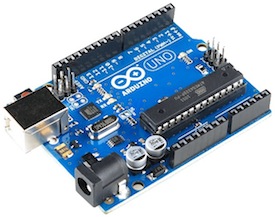
Arduino Uno chipKIT Uno32

Read more

« Older Entries Recent Entries »