Author Archives: R-B

A brief overview of Allegro ACS712 current sensor (Part 2)

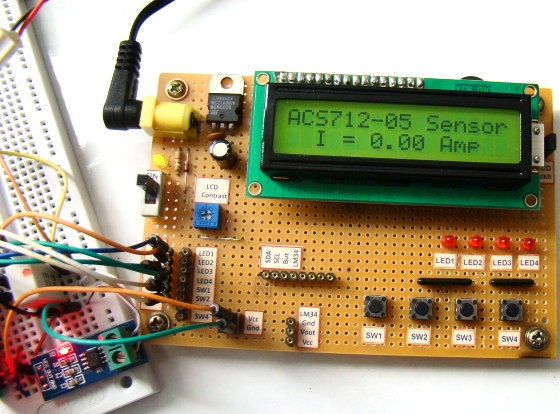
In the first part of this discussion, the features of ACS712 device were briefly discussed. Now we will use that theory to implement the ACS712 sensor to make a simple DC current meter. The analog output voltage from the sensor is measured through an ADC channel of the PIC16F1847 microcontroller. A voltage to current conversion equation will be derived and implemented in the firmware of the PIC microcontroller and the actual load current will be displayed on a character LCD.

Measuring dc current with ACS712 sensor

Read more

A brief overview of Allegro ACS712 current sensor (Part 1)

Sensing and controlling current flow is a fundamental requirement in a wide variety of applications including, over-current protection circuits, battery chargers, switching mode power supplies, digital watt meters, programmable current sources, etc. One of the simplest techniques of sensing current is to place a small value resistance (also known as Shunt resistor) in between the load and the ground and measure the voltage drop across it, which in fact, is proportional to the current flowing through it. Whereas this technique is easy and straightforward to implement, it may not be very precise because the value of the shunt resistor slightly varies with its temperature, which in fact is not constant because of the Joule heating. Besides, this simple technique does not provide an isolation between the load and current sensing unit, which is desirable in applications involving high voltage loads. Today, we will talk about Allegro ACS712 device which provides an economical and precise way of sensing AC and DC currents based on Hall-effect. This discussion is divided into two parts. The first part will provide a brief overview of the ACS712 sensor and its characteristics. In the second part, a test experiment will be carried out to interface the sensor with a PIC microcontroller to measure a dc current.
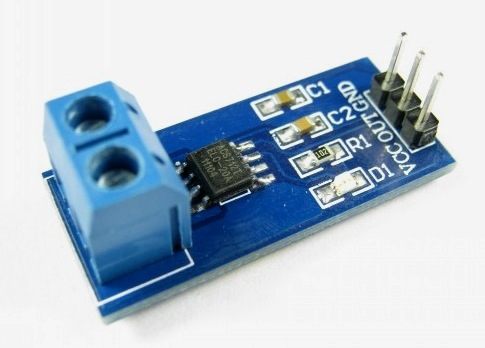
ACS712-05 current sensor module

Read more
Building a digital light meter with a calibrated LDR

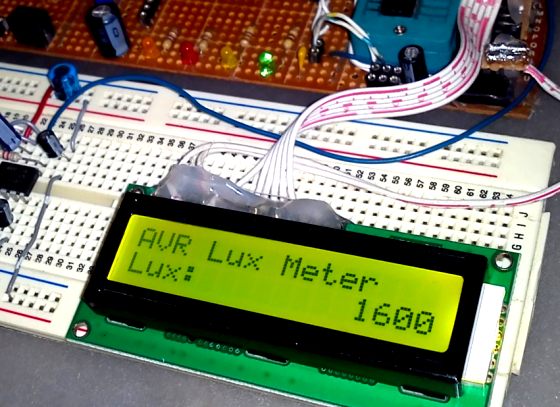
Measurement of light intensity is a prime necessity in several occasions.  The diversity of such needs make their way to various branches of physics and engineering as well as in media. For instance, in engineering, such kinds of measurements are needed to design optimum lighting conditions of a room. In photography, light intensity measurements ensure good quality pictures by determining the right exposure. Wiring a phototransistor or a light-dependent-resistor (LDR) with an analogue LED voltmeter chip like the LM3914 or even to a microcontroller and displaying the ADC values is a pretty simple technique of measuring light intensity. The bad part of this technique is that these simple and amateur-level devices can only measure relative intensity of light and are unable to provide measurements on an absolute scale. However, with a precise knowledge of the transfer characteristic (resistance vs light intensity) of the LDR it is possible to relate the LDR output to the intensity of light in standard unit. In case the LDR characteristic is unknown or unreliable, you can still calibrate the sensor output by using a variable light source and an external reference photometer. This project is about a microcontroller based light intensity meter where an LDR light sensor is calibrated against an external photometer to obtain the intensity of incoming light in the unit of lux. The lux is the SI unit of illuminance and luminous emittance, and measures lumens per square meter (lm/m2). The microcontroller used in this project is ATMega8L and its firmware is written using mikroElektronika’s MikroC Pro for AVR compiler.

AVR based LUX meter

Read more

Measurement of temperature and relative humidity using DHT11 sensor and PIC microcontroller

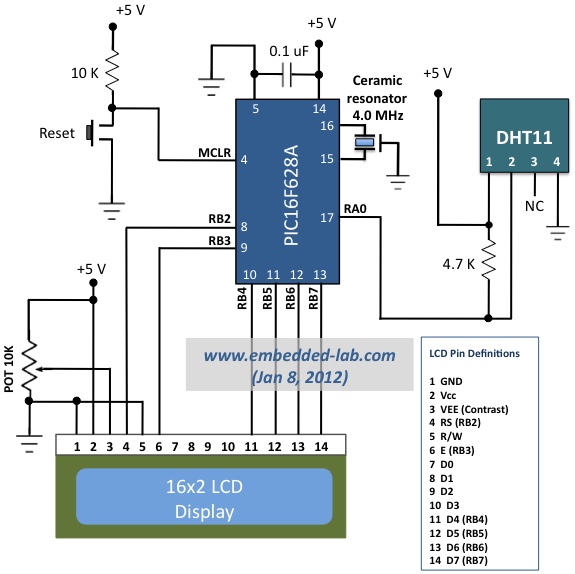
Measurement and control of temperature and relative humidity finds applications in numerous areas. These days devices are available which have both temperature and humidity sensors with signal conditioning, ADC, calibration and communication interface all built inside them. The use of such smart sensors greatly simplify the design and reduces the overall cost. We discussed in past about Humidity and temperature measurements with Sensirion’s SHT1x/SHT7x sensors. These sensors are capable of measuring both temperature and relative humidity and provide fully calibrated digital outputs. While  SHT1x/SHT7x are very accurate sensors, they are still expensive for hobbyists use. This articles discusses the DHT11 sensor which also provides calibrated digital outputs for temperature and humidity but is relatively lot cheaper than the Sensirion sensors. The DHT11 sensor uses a proprietary 1-wire protocol which we will be exploring here and implementing with the PIC16F628A microcontroller that will receive the temperature and humidity values from the sensor and display them on a 16×2 character LCD.

Interfacing DHT11 sensor with PIC16F628A

Read more

Embedded Lab projects built by Kevin Murphy

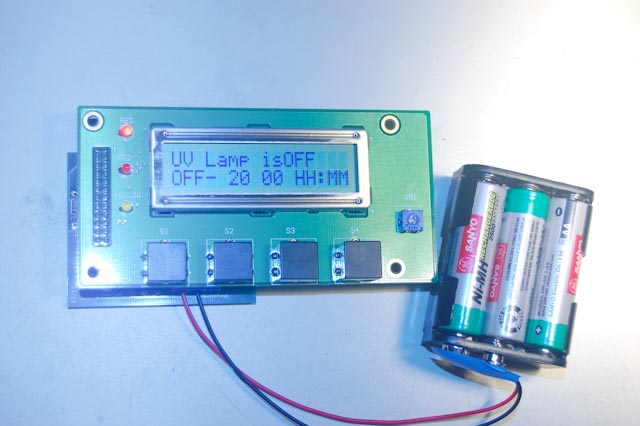
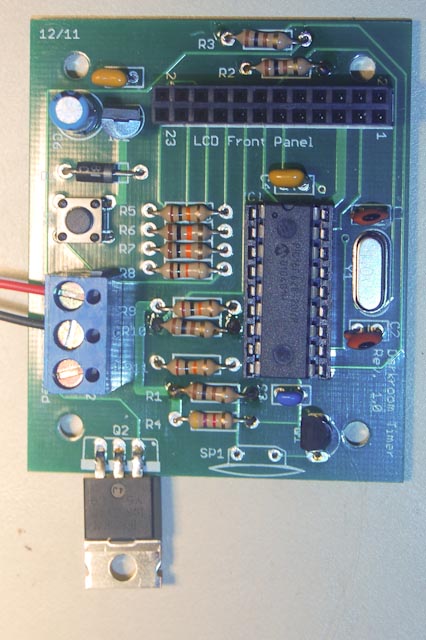
Kevin Murphy from New Boston, Michigan is a regular reader of Embedded Lab. He adapted our digital timer project to fulfill his need of a programmable timer switch for his darkroom. Here are some pictures that he has sent us showing how his assembled PCB of this project look like.

Dark room timer

Dark room timer assembled board

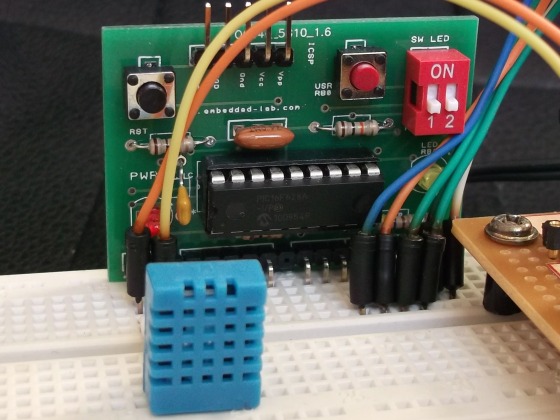
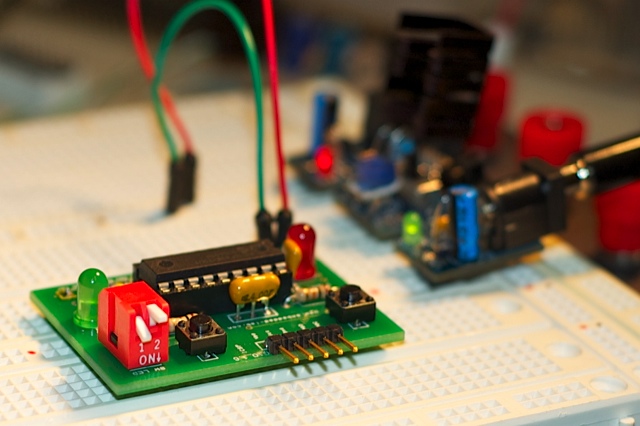
He also received a PCB for the 18-pin PIC16F board from us last week. The following pictures shows his assembled breadboard module for PIC16F628.

PIC16F628 breadboard module

The board with an external power supply

Thank you, Kevin for sharing these pictures with us.

« Older Entries Recent Entries »