Author Archives: R-B

How to interface MAXIM’s DS1868 digital potentiometer with a PIC microcontroller
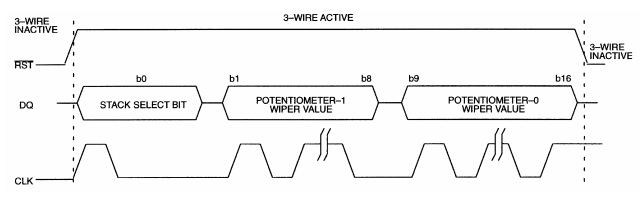
Potentiometers find applications in many electrical devices. For example, a light dimmer uses a potentiometer to control the brightness of lamps. In amplifiers, they are used to control the output volume of the music, or change the bass level. In an adjustable power supply we see potentiometers to vary the output voltage and current. In a frequency generator, they are used to control the duty cycle and frequency of the output signal. These potentiometers are electro-mechanical transducers that convert the rotary or linear displacement into a change in resistance. This change in resistance can be used to control anything from the brightness of a lamp to the direction of a rocket. But things have been changed lately. You can now vary the brightness of the lamp with touch switches. The volume of an amplifier can be controlled through a remote, and the frequency of an oscillator can be varied with tact switches. There are still potentiometers in these devices but in the form of silicon chips and not in the conventional electro-mechanical form. These are called digital potentiometers and today we will discuss about MAXIM’s DS1868 chip, which has two digitally controlled potentiometers. We will interface it to a PIC16F1827 microcontroller and vary the position of the wiper terminals from one end to the other.
Controlling the wiper position of DS1868 digital potentiometer
Read more

Experimenter’s board for enhanced mid-range PIC microcontrollers (PIC16F1827 and PIC16F1847)

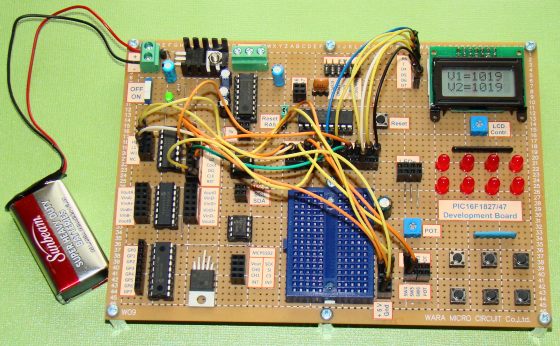
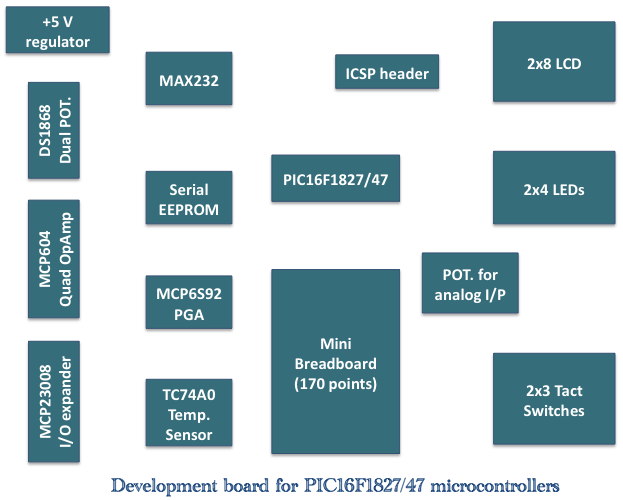
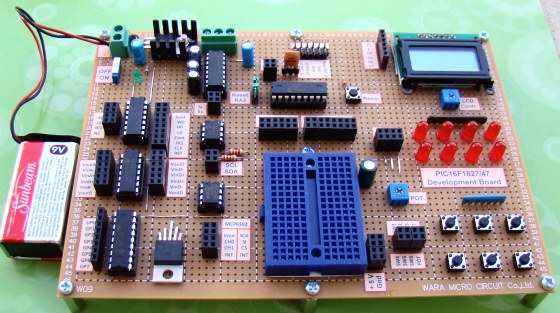
The PIC16F628A has always been my first choice for microcontroller-based projects. It is simple, inexpensive, and easily available. Due to its compact size (18 pins) it occupies lesser space on the circuit board, and meanwhile, it is powerful enough to serve most of a hobbyist’s needs. It is a very well accepted successor of the classic PIC16x84, and therefore, the tons of resources available for PIC16x84 on the internet and books can also be used for PIC16F628A. Last month, Microchip Technology Inc. announced the latest addition to its Enhanced Mid-Range core 8-bit PIC® microcontroller (MCU) family by introducing PIC16F(LF)1847. When I went through its features I was tempted. The newly released PIC16F1847 seems to be the most powerful successor of the 18-pin PIC16F series of microcontrollers. It is pin-compatible with PIC16F628A but equipped with lot more peripherals and enhanced features. It has 14Kbytes of on-chip flash memory and 1KByte of data RAM. Now I never have to switch to a higher-end or bigger size PIC just because of the shortage of program memory or RAM. This would probably be the first 18-pin PIC device of the mid-range 8-bit family with so much of RAM and flash memory. Before this, Microchip also released PIC16F1827, similar to PIC16F1847 in peripherals and other features but with lesser program memory. I thought of doing some experiments with these two members of enhanced mid-range 8-bit PIC family and so decided to make my own development board for PIC16F1827/47. Making a development board is a one-time effort, and life becomes much easier after that.

Development board for PIC16F1827/47

Read more

Mini development board for 32-bit PICMicro

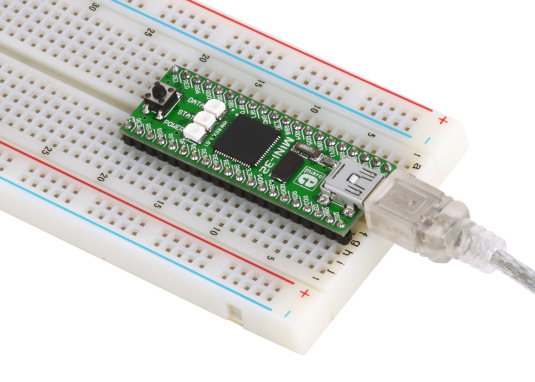
MikroElektronika recently released a mini development board (MINI-32) containing PIC32MX534F064H microcontroller. It operates on 3.3V power supply. The on-board voltage regulator allows the board to be powered directly from USB cable. The board is equiped with SMD crystal oscillator, and 32.768KHz crystal which can be used for internal RTCC module. It has reset button and three signal LEDs. Board comes preprogrammed with fast USB HID bootloader, so no external programmers are needed for development. It could be a very good development board for experimenters who love to do experiments on breadboard.

Mini-32 board plugged in to breadboard

Read More

Microchip and Stratford Digital releases 16-bit microcontroller development platform for Educators

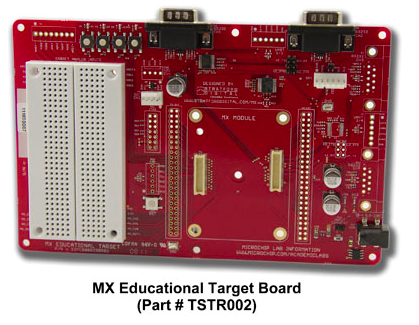
Microchip Technology Inc., a leading provider of microcontroller, analog and Flash-IP solutions, and Stratford Digital, today announced a full, turnkey, 16-bit microcontroller development platform that enables educators to quickly and easily integrate Microchip into their curriculum.  The PIC24-based platform includes two boards—the MX PIC24 Module (part # TSTR001) and MX Educational Target Board (part # TSTR002)—and a free software download of an Educator’s Lab Manual, including 10 unique labs on topics ranging from “Intro to Microcontrollers,” to timers, Pulse-Width Modulation and Analog-to-Digital Converters, to power management.  Microchip will be demonstrating the platform at its booth, # 647, at the American Society of Engineering Education (ASEE) Annual Conference & Exhibition June 26 – 29 in Vancouver, B.C.

The MX PIC24 Module includes an onboard PIC24FJ256GB110 16-bit microcontroller from Microchip that features 256 KB Flash program memory and 16 KB RAM.  The module also includes 32 KB on-chip EEPROM and an onboard debugger/programmer. The MX Educational Target Board accepts any MX module and includes a breadboard area, plus SPI, I2C™, RS-232, CAN and JTAG ports, along with four LEDs.  General tools needed for the Lab Manual, such as Microchip’s MPLAB® IDE v.8.63, are also included.

Read more

Expanding the number of I/O lines using Microchip MCP23008

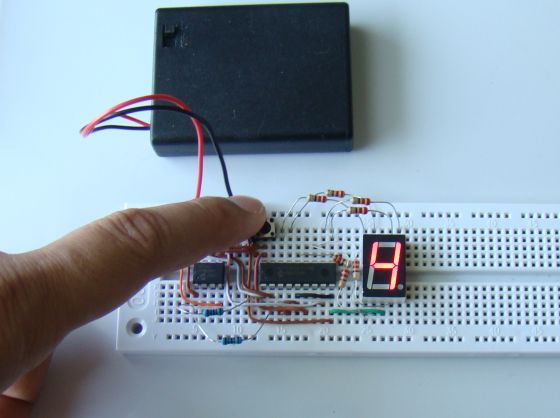
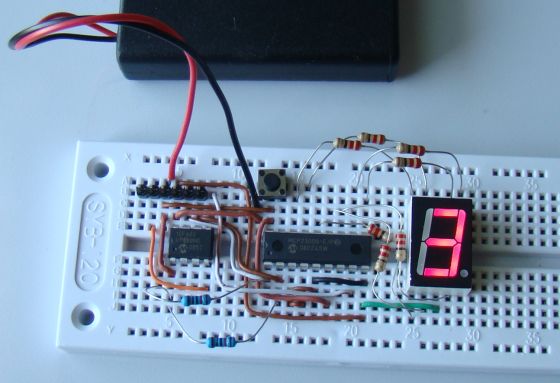
A microcontroller comes with a limited number of general purpose input and output (GPIO) ports. However, some applications may require more ports than are available on the microcontroller. In such a case, GPIO expanders can be used to increase the I/O capability of the microcontroller. MCP23008 is one such device (manufactured by Microchip Technology) which provides an easy I/O expansion using 2-wire serial interface. This tutorial illustrates how to add an extra 8-bit I/O port to PIC12683 microcontroller (which has only 6 I/O pins) using MCP23008. A seven segment LED display and a tact switch will be connected to the extended port. The PIC12F683 microcontroller will count the switch presses and display the counter value on the seven segment LED  module.

MCP23008 port expander interfaced to PIC12F683

Read more

« Older Entries Recent Entries »