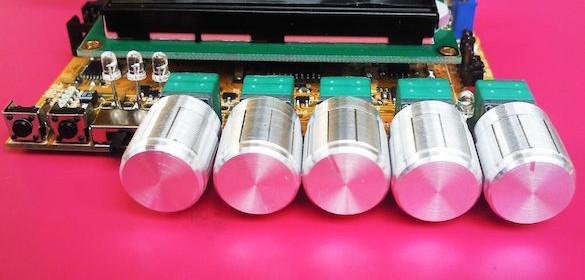
Dual USB-to-UART/I2C interface board
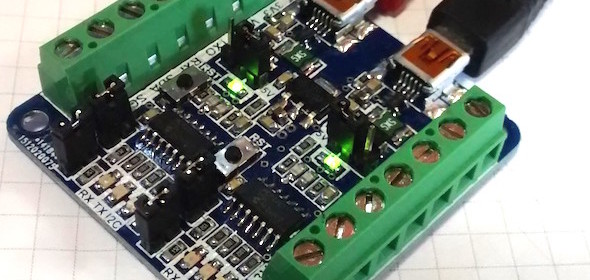
Jesus Echavarria‘s new project is a dual USB-to-UART/I2C serial interface board using two MCP2221 chips. This board can be used for debugging UART TX and RX lines as well as providing an USB connectivity in applications that have UART and I2C interfaces. With the help of Microchip’s free PC utilities, you can customize the MCP2221 identifiers and GPIO pins as well as directly communicate with any UART and I2C devices from its GUI interface for rapid prototyping with those devices. MCP221 USB/Serial bridge (A): the basic connection for the MCP2221 converter. It has a small R-C filter on USB lines and a Reset pushbutton.

Read more
RGB LED matrix clock with IR control

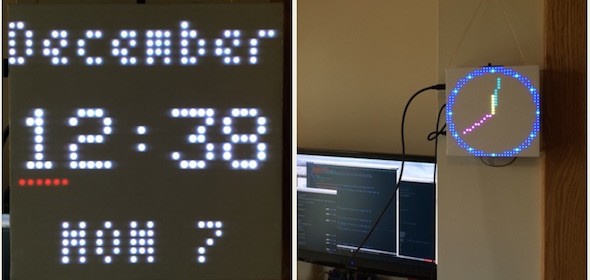
Sam Miller and Craig Andres designed a wall-mounted RGB LED matrix clock as their final project for the ECE 4760 course on Designing with Microcontrollers at Cornell. The clock consists of a 32×32 RGB LED matrix, which is controlled using the PIC32MX250F128B microcontroller. The clock also features stopwatch operation and alarm that can be customized through an IR remote. The clock also connects to a PC through a serial interface to synchronize the time with the RTC running on the PC. They write, Our project runs off of a PIC32MX250F128B microcontroller, which handles all the controls and processing of data for the

Read more

PIC32 Project: Hand gesture lock

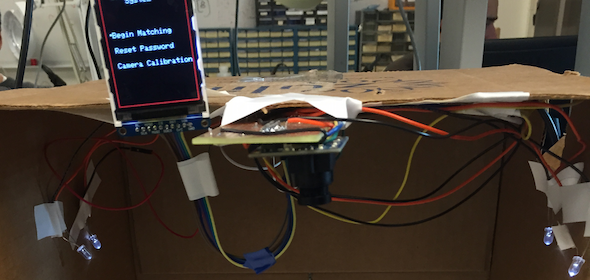
Rex Chen and Ziqi Yang have built a hand gesture lock system that utilizes a series of hand signs as a password to authenticate. The pattern of hand signs are imaged through a CMOS image sensor, and are analyzed using a PIC32 microcontroller to determine whether the observed sequence of the gestures match with the one that is pre-recorded into the system. The Hand Sign Lock demonstrates the high-level design of the project and can be divided into four main parts: CMOS camera, control, PIC32 microcontroller, and thin film transistor (TFT) screen. The OV7670 CMOS camera provides images for the PIC32 microcontroller, and the buttons

Read more

Another tutorial on using NRF24L01 wireless modules with Arduino

educ8s.tv has posted a new video tutorial on how to connect two Arduino modules with low-cost NRF24L01 wireless modules. The NRF24L01 module is a low cost bi-directional transceiver module. The cost of it is less than 3$! You can find a link for it in the description of the video. It operates at the 2.4GHz band and it can achieve at a data rate of 2Mbits! Impressive isn’t it? It uses the SPI interface in order to communicate with Arduino, so it is very easy to use with it. We have to connect 7 of the 8 pins of the

Read more

MAX038 function generator

Milen posted this Instructable on the design of a MAX038 function generator that also implements an Atmega328 and an LCD to display the parameters. The function generator is very useful tool for the electronics freaks. It is needed for tuning resonance circuits, testing audio and video equipment, designing of analog filters and for many other different purposes. Today there are two main types of function generators ; digital, (DSP based, DDS…) which are more and more often used and analog, which were the origins. Both types have their advantages and disadvantages. The digital generators can generate signals with very stable

Read more
« Older Entries Recent Entries »