LED light dimmer using PIC16F1936
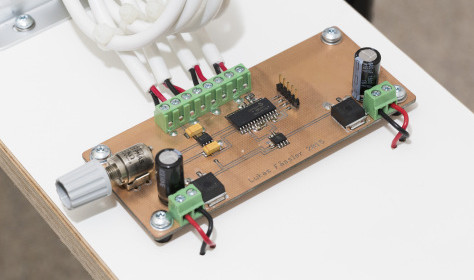
Lukas Fassler recently moved to a new apartment and he wanted to have a PWM LED light dimmer to control some of his 12V LED strips. When he didn’t find a ready-made one that would meet his requirements, he designed his own using the PIC16F1936 MCU. His PWM dimmer can handle 100W output power at 12V DC. At the center of my design is a 8-bit PIC microcontroller, a PIC16F1936. There’s not much special about this particular model, it’s just a type I’ve used several times before and still had some on stock. A LM2931 provides the PIC with 5 volts

Read more
Microchip launches MPLAB XPRESS, a Free, Cloud-based Development Platform for PIC MCUs

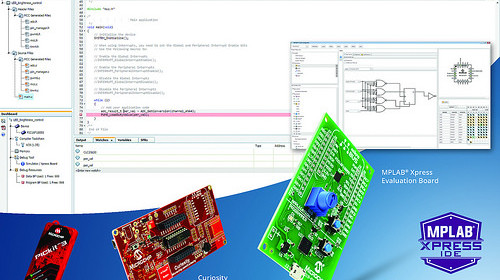
Today, Microchip Technology Inc. has launched MPLAB Xpress, a cloud based development environment with the most popular features of the MPLAB X IDE. Microchip Technology Inc. (NASDAQ: MCHP), a leading provider of microcontroller, mixed-signal, analog and Flash-IP solutions, today announced its MPLAB® Xpress Cloud-based Integrated Development Environment (IDE).  This online development platform is the easiest way to get started with PIC® microcontrollers (MCUs), with zero downloads, sign-in or setup needed to start designing.  Microchip’s free, cloud-based IDE brings the most popular features of the award-winning MPLAB X IDE to Internet-connected PCs, laptops or tablets.  MPLAB Xpress offers the industry’s most comprehensive feature

Read more

Wireless storage with biometric protection

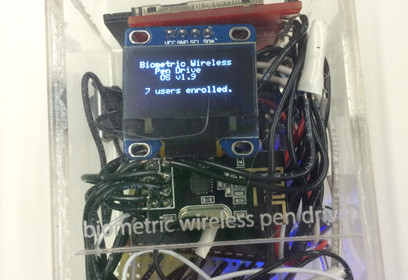
Nathan Spallone and Zhiyuan Teo from Cornell University designed a wireless storage with biometric protection as their final project for Bruce Land‘s ECE 4760 course. Their design uses a fingerprint scanner for authorization and an induction coil for wireless charging. The user can authenticate into the storage system by simply placing a thumb on the fingerprint sensor and can sync the drive to a home station wirelessly using an nRF24l01+ transceiver module. The home station also usesan nRF24l01+ transceiver module along with an Arduino board, which is connected to a PC over USB. They also wrote a PC application to allow the user to read and

Read more

Standalone LED tester

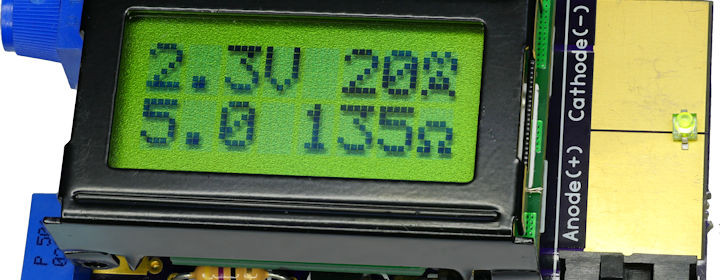
David Cook’s new handy LED tester is based on the LM317L adjustable current regulator and consists of a microcontroller and an LCD to display the forward bias voltage across the LED and required series resistance for operation at the user-specified current and circuit voltage. Most projects include at least one LED. Before soldering the LED, how can you determine if the color and brightness meets your needs? After that, how do you calculate the correct value resistor? Many years ago, I built a handy compact LED testing tool based on the LM317L adjustable current regulator. (You’ll definitely want to click on

Read more

Arduino Infrared thermometer

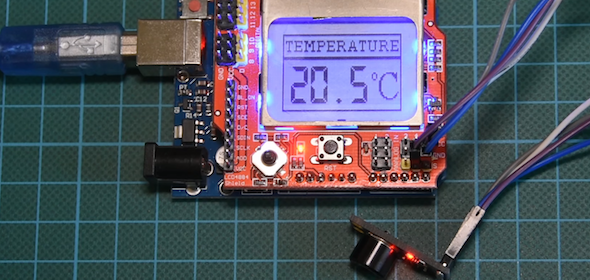
educ8s.tv has posted another great video tutorial on building an Arduino infrared thermometer using the MLX90614 Infrared temperature sensor, which uses the standard I2C protocol to communicate with the Arduino. The measured temperature is displayed on a Nokia 5110 LCD display shield. The device can measure the temperature of an object without any physical contact and with just facing the sensor toward it from a small distance. It can measure temperatures from -70 degrees Celsius to 380 degrees with an of about 0.5 degree at room temperature. Demo video showing it in action.

Read more
« Older Entries Recent Entries »