Author Archives: R-B

Interfacing an external ADC chip to FPGA/CPLD
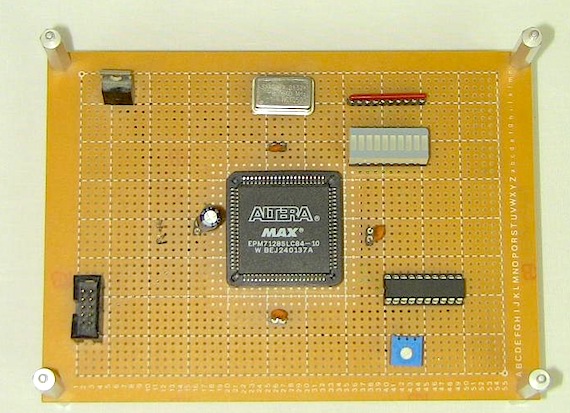
Chris (from PyroElectro) has posted an article on interfacing an external ADC chip to FPGAs and CPLDs, which do not have A/D capabilities built-in. He illustrates the idea with an Altera EPM7128 and a MAX150 8-bit analog to digital converter IC. The test analog signal is derived using a potentiometer and the converted digital output is shown using an LED bargraph display. The interface between the CPLD and ADC has been implemented in VHDL.
Interfacing an ADC to CPLD
 

Digital logic probe for troubleshooting TTL and CMOS circuits

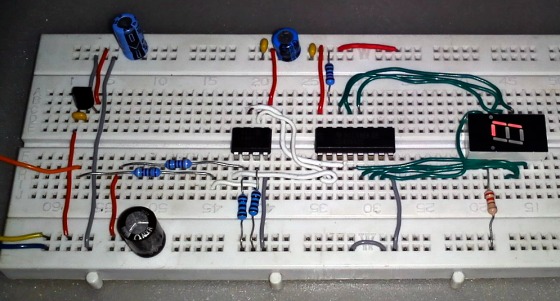
A logic probe is considered as a stethoscope for engineers and technicians for debugging digital logic circuits that consists of logic gates, memories, registers, etc. A digital multimeter (DVM) can also be used for such analytical purposes but it gives you the numeric value of the voltage at a point instead of the logic state. Depending on whether the circuit is based on TTL or CMOS components, the voltage levels for logic 0 and 1 could be different for each family. DVM users, thus, have to calculate logic levels from the measured voltages, which consumes time and delays the troubleshooting procedure. A logic probe, on the other hand, does all these functions automatically and shows meaningful logic states at test points. In this project, we will discuss about making a digital logic probe that is applicable to both TTL and CMOS circuits and uses minimal components.

Logic probe for CMOS and TTL circuits

Read more

Lab 21: Servo motor control

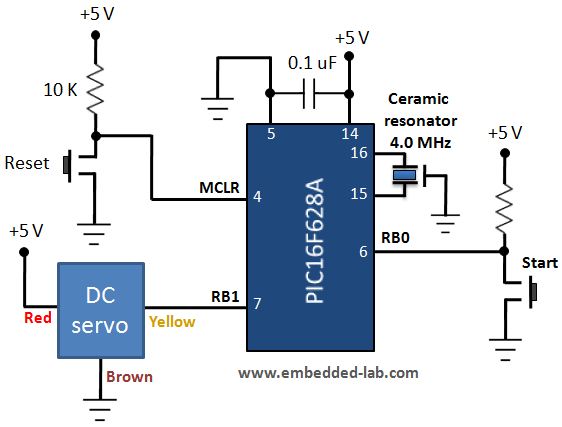
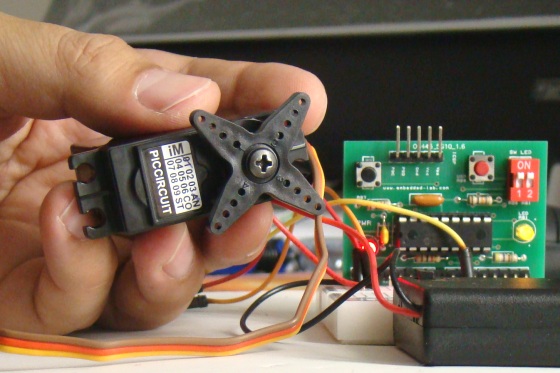
A servo motor is a special geared DC motor equipped with an electronic circuit for controlling the direction of rotation, as well as the position, of the motor shaft. Because servo motors allows precise angular positioning of their output shaft, they are used extensively in robotics and radio-controlled cars, airplanes, and boats to control the motion of their various parts. In this lab session, we will first explore what a servo motor consists of and how it works and then illustrate how to interface it with a PIC microcontroller.

Servo motor control using PIC microcontroller

Read more

Using CMOS camera for sensing applications

Ibrahim Kamal from IKALOGIC informed me about his latest article on the use of CMOS camera for sensing applications posted on his website. It’s true that interfacing a CMOS camera with 8-bit microcontrollers has not been very common. There’s a stereotype that much faster and powerful microcontrollers are required to process the output of a CMOS camera, which may not always be true, as illustrated by Ibrahim Kamam. In fact, it all depends on the type of application you choose with a CMOS camera.

CMOS camera can replace an array of photo sensors

The article discusses about the possibility of using a CMOS camera for sensing applications by reducing the image resolution and getting rid of the color information. The downgraded image requires lesser computation, and therefore, is feasible to process using a simple 8-bit microcontroller. With this arrangement one CMOS camera could replace an array of conventional light sensors (made of LEDs and photodiodes) that are used in many embedded applications including robotics. A quick illustration on how to interface the TCM8230MD CMOS camera (available from SparkFun) to an AVR XMEGA processor has also been discussed in the article.

Another LUX meter using MAX44007 ambient light sensor

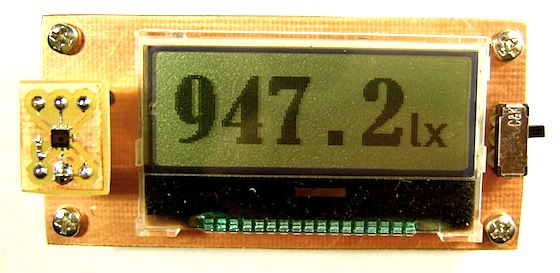
In his digital light meter project, Shawon Shahryiar demonstrated a technique of using a normal LDR to construct a simple LUX meter that outputs the ambient light conditions on an LCD display. While this technique is simple and cost-effective, it requires an additional reference photometer to calibrate the LDR first adding an additional step. I came across this another LUX meter project on University of Wisconsin-Superior website that eliminates the need of external calibration and provides very precise measurement of illuminance in the range of 0.025 – 99999 LUX.

Digital LUX meter using MAX44007 (Source: http://mcs.uwsuper.edu/sb/Electronics/Lux/)

This project uses Maxim’s MAX44007 ambient light sensor which features an integrated photodiode with onboard ADC and I²C digital output. The sensor is designed to operate from a 1.7V to 3.6V supply voltage and consumes only 0.65µA in full operation. It has an extremely large dynamic light range that extends from 0.025 lux to 104,448 lux. The microcontroller used in this project is Silicon Laboratories C8051F304, but the sensor can be interfaced to any other microcontroller with I2C capability.

« Older Entries Recent Entries »