Author Archives: R-B

Humidity and temperature measurements with Sensirion’s SHT1x/SHT7x sensors (Part 2)
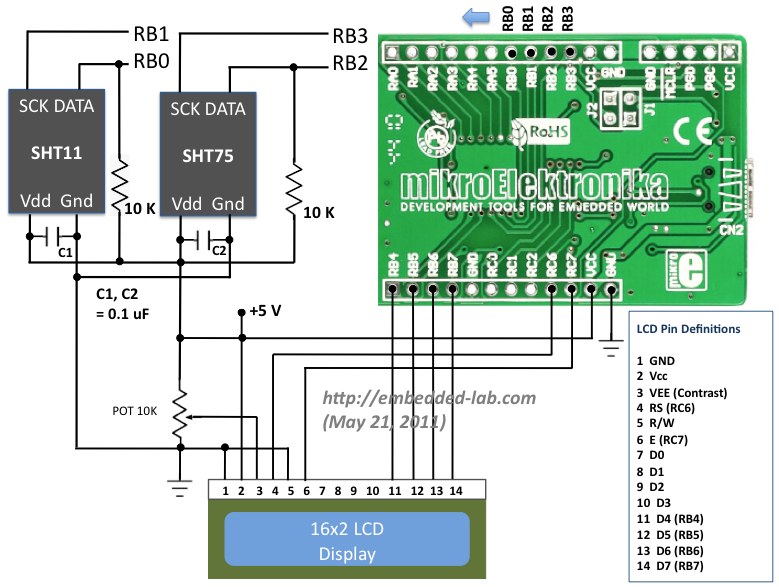
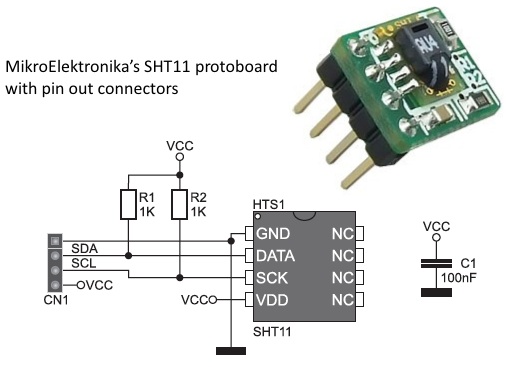
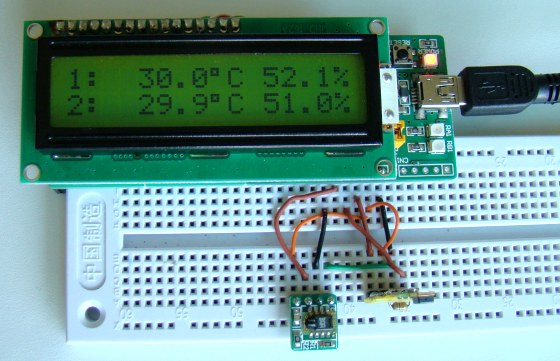
In Part 1 of this tutorial, we discussed about Sensirion’s SHT1x and SHT7x series of humidity sensors, their interface specifications, the communication protocol used for transferring data in and out of the sensor, and the equations to convert their digital outputs to actual physical quantities. These sensors are capable of measuring temperature along with relative humidity and provide outputs in fully-calibrated digital words. We will now see how a PIC microcontroller can be programmed to communicate with these sensors, read the temperature and relative humidity data, and display the information on a character LCD.
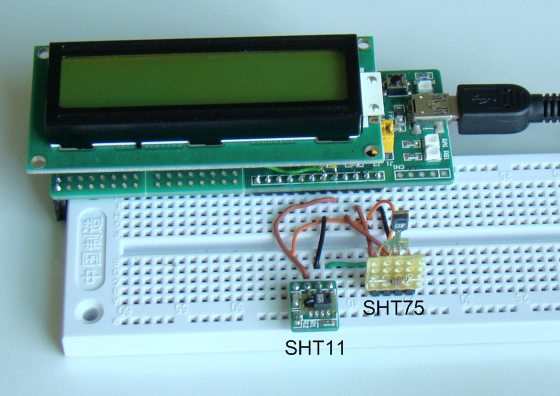
Circuit setup on breadboard
Read more

Humidity and temperature measurements with Sensirion’s SHT1x/SHT7x sensors (Part 1)

Temperature and relative humidity are two very important ambient parameters that are directly related to human comfort. Sometimes, you may be able to bear higher temperatures, if there is a lower relative humidity, such as in hot and dry desert-like environment. However, being in a humid place with not very high temperature may make you feel like melting. This is because if there is high relative humidity, sweat from our body will evaporate less into the air and we feel much hotter than the actual temperature. Humidifiers and dehumidifiers help to keep indoor humidity at a comfortable level. Today we will discuss about Sensirion’s SHT series of digital sensors, more specifically SHT11 and SHT75, which are capable of measuring both temperature and relative humidity and provide fully calibrated digital outputs. We will interface both the sensors to PIC18F2550 microcontroller and compare the two sets of  measurements to see the consistency between the two sensors. This tutorial is divided into two parts. The first part will cover all the details regarding the sensors, including their specification, interface, and communication protocol. The second part will be more focussed on the circuit diagram, implementation of the communication protocol with PICMicro, and the results.

Relative humidity and temperature measurements with SHT1x and SHT7x sensors

Read more

Can’t access to Microchip’s website this morning

When I tried to access microchip.com this morning, the page didn’t show up. This is what I have been seeing. I can’t access to any information and datasheets. Is anybody else having the same issue?

.

Sorry, it was my bad, I have this problem with one of my machines, but it’s working good on other machines. I should have checked this before.

Lab 15: Scrolling text message on an LED dot-matrix display

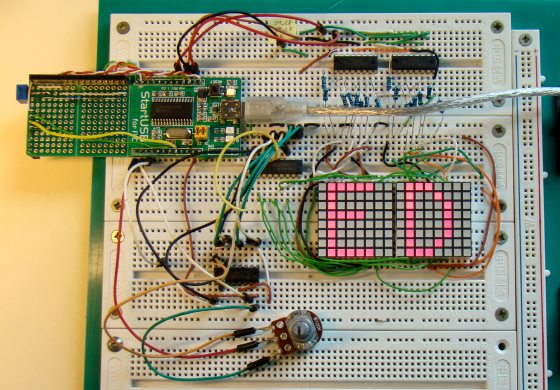
In Lab 12, we learned about the basic structure of a monochrome (single color) LED dot matrix and its interface with a microcontroller to display static characters and symbols. Today’s lab is its continuation, and we will be discussing on displaying a scrolling text message on a 16×8 LED dot matrix. The microcontroller used is again the same PIC18F2550 from StartUSB for PIC board. The 16 columns of the LED matrix are driven individually by two shift registers (74HC595), whereas the eight combined rows are driven by the decoded outputs from a decade counter (CD4017). In Lab 12, columns were scanned, but here we will be scanning across the rows and feed the column lines with appropriate logic levels. An analog input from a potentiometer is read by the microcontroller to determine the speed of the scrolling message. The technique will be demonstrated for right to left scroll, but can be easily implemented for scrolling in other directions. The program for PIC18F2550 is developed with mikroC Pro for PIC compiler.

Scrolling message display on 16x8 LED dot matrix

Read more

Lab 14: Inter-Integrated Circuit (I2C) communication

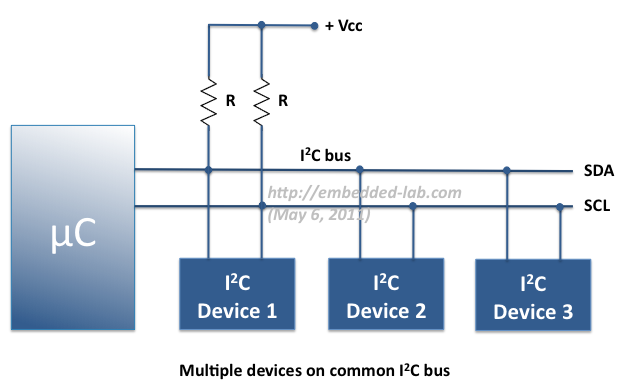
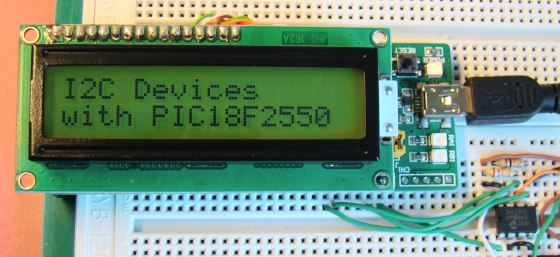
I2C (Inter-Integrated Circuit) is a short distance serial interface that requires only 2 bus lines for data transfer. It was invented by Philips in 1980’s, originally to provide easy on-board communications between a CPU and various peripheral chips in a TV set. Today, it is widely used in varieties of embedded systems to connect low speed peripherals (external EEPROMs, digital sensors, LCD drivers, etc) to the main controller. In this experiment, we will cover an overview of I2C protocol, its implementation in PIC microcontrollers, and the method of connecting single and multiple devices on a common I2C bus. We will demonstrate the technique by connecting two I2C EEPROM chips (24LC512) and an I2C compatible temperature sensor (DS1631) with PIC18F2550 microcontroller.

I2C devices with PICMicro

Read more

« Older Entries Recent Entries »